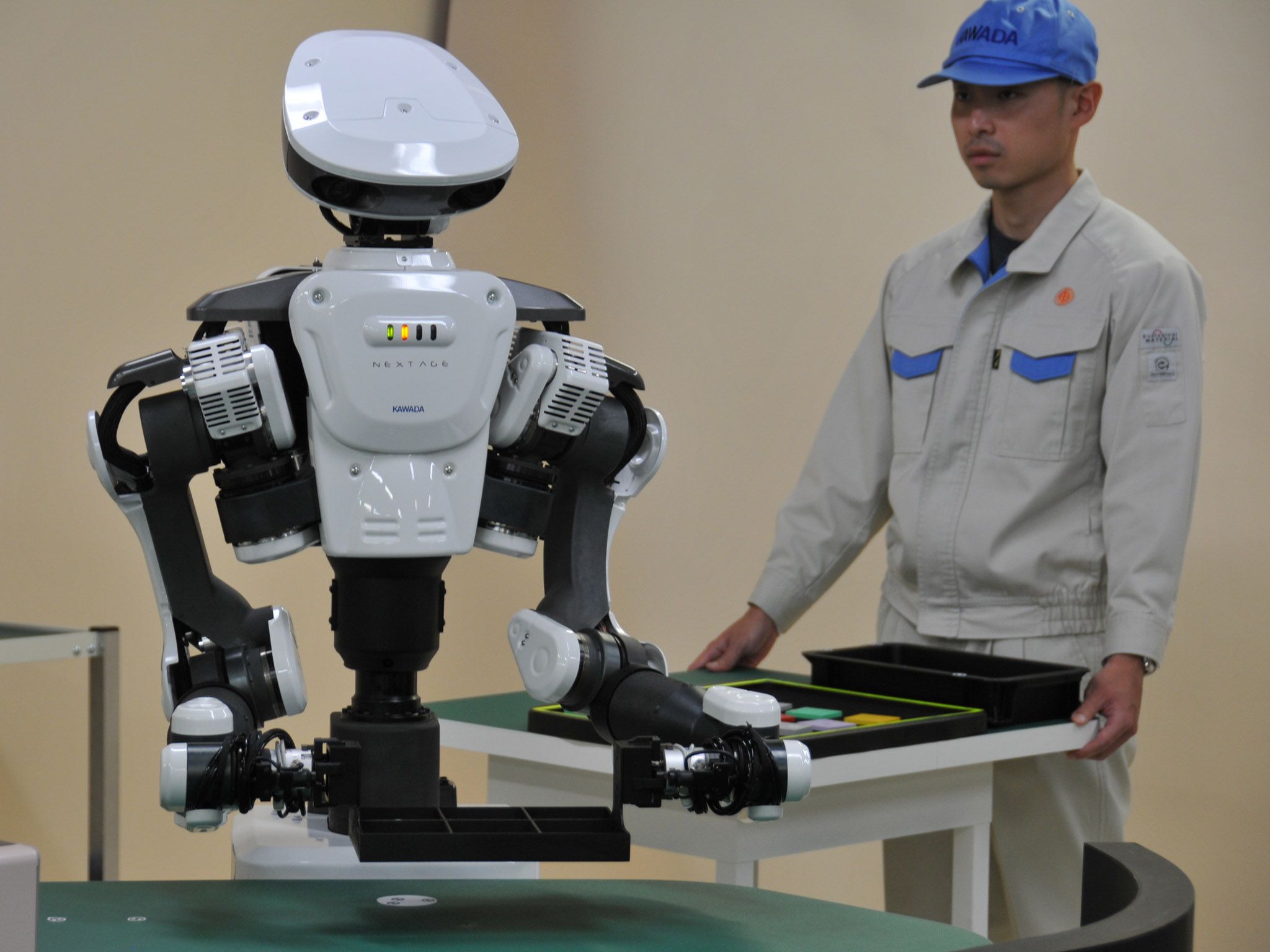
Tokyo-based Kawada Robotics has unveiled the NEXTAGE S, the latest evolution of its landmark collaborative humanoid platform — and the first to feature onboard AI capable of learning new assembly tasks from a single human demonstration. The announcement cements Japan's position as the precision-automation leader in Asia's humanoid ecosystem.
What's New in NEXTAGE S
The NEXTAGE S builds on over two decades of Kawada's experience in dual-arm cobot development. Where previous NEXTAGE models required extensive programming for each new task, the S-series introduces a "teach-by-demo" interface: a human operator performs an assembly sequence once while wearing lightweight motion-capture gloves, and the robot generates a generalised motion policy that it can execute reliably across parts with minor dimensional variation.
The platform features 15 degrees of freedom across its two arms and torso, a new force-torque sensor suite at each wrist, and a stereo vision system upgraded to 4K resolution at 60 frames per second. Its reach envelope has been extended by 8% versus the previous NEXTAGE model, covering a wider workstation footprint without requiring the robot to be repositioned.
Weight has been reduced to 29 kilograms — a 12% improvement — through extensive use of carbon fibre composite in the arm structure, a change that also improves payload-to-weight ratio for fine assembly tasks.
Japan's Factory Automation Imperative
The NEXTAGE S arrives at a moment of acute urgency for Japanese manufacturers. Japan's working-age population is shrinking at a rate of approximately 600,000 per year, and the manufacturing sector — which employs 16% of the national workforce — is struggling to fill skilled assembly roles that require dexterity and judgement beyond what traditional industrial robots can provide.
Automotive and electronics manufacturers have been the primary adopters of Kawada's existing NEXTAGE platform. Toyota, Denso, and Panasonic all operate NEXTAGE units on precision assembly lines. With the S-series, Kawada is targeting a broader set of use cases: pharmaceutical packaging, semiconductor component handling, and surgical instrument assembly — sectors where tolerance requirements are measured in microns and contamination risk is zero-tolerance.
Competitive Positioning in Asia
Kawada's approach differs sharply from Chinese competitors like AGIBOT and Unitree. Where those companies optimise for general-purpose mobility and low unit cost, Kawada targets high-precision, high-value applications where Japanese manufacturers will pay a premium for reliability. The NEXTAGE S carries a suggested list price of approximately ¥8.5 million ($57,000) — roughly 60% more than an AGIBOT A2 unit — but targets tasks where a single defect can cause recalls costing tens of millions of dollars.
The distinction reflects Japan's broader manufacturing philosophy: kaizen-driven quality over cost-driven volume. Kawada's customers typically deploy 5–20 units per facility in targeted applications rather than the large-scale deployments seen at Chinese automotive plants.
The AI Learning Layer
The most strategically significant element of the NEXTAGE S is its AI stack. Kawada has partnered with Preferred Networks — Japan's leading robotics AI firm — to integrate a proprietary imitation learning system trained on Kawada's 20-year library of factory motion data. The result is a system that generalises better to novel tasks than competitors trained purely on simulation data.
Early customer pilots at a Tier 1 automotive supplier in Aichi Prefecture reportedly showed the robot learning a new 12-step connector assembly task in under 45 minutes of demonstration time — compared to the 3–5 days of programming required for the previous NEXTAGE model. Yield rate on the learned task was 99.2% after 24 hours of operation, meeting automotive-grade quality standards.
Availability and Roadmap
The NEXTAGE S enters general availability in Japan in Q2 2026, with international distribution through Kawada's existing network covering South Korea, Taiwan, Singapore, and Australia. A version integrated with NVIDIA's Isaac ROS framework — for compatibility with NVIDIA-based factory management systems — is planned for Q4 2026.