At a glance
Leju and Zhaofeng announced a Kuavo automotive-parts loading deployment on October 15, 2026, with 15 robots reportedly in routine operation. The performance figures come from a Leju-sourced media account and lack disclosed measurement methods or independent verification. Gongkong
Leju and Zhaofeng report routine Kuavo operation on a parts line
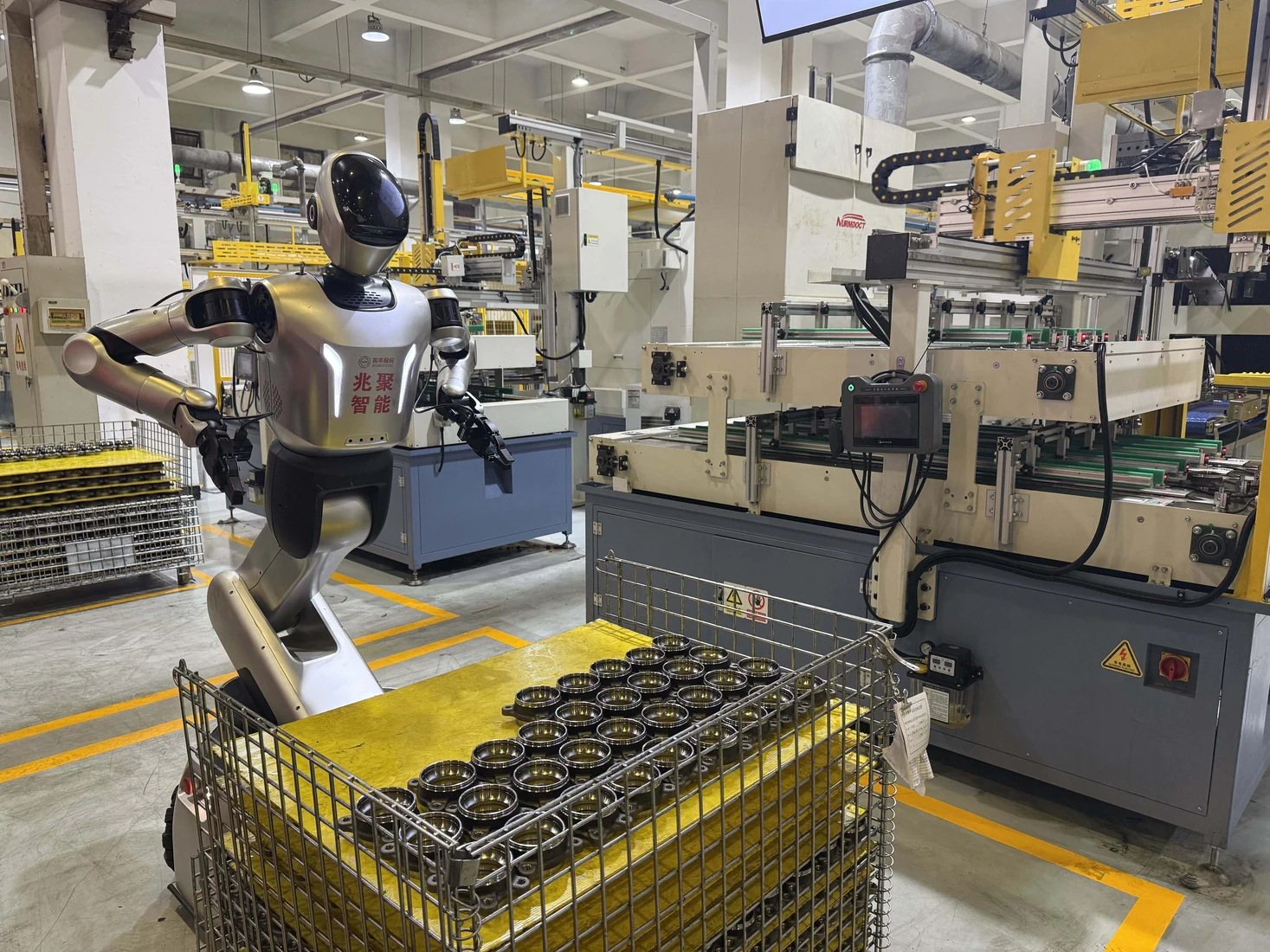
On October 15, Leju Robotics and Zhaofeng Electromechanical jointly announced an embodied-AI solution for loading automotive parts, according to a Gongkong account sourced to Leju. The report says 15 Kuavo humanoid robots have entered routine operation on Zhaofeng’s production line. Gongkong’s report on the Kuavo factory deployment
The reported application is a specific factory task: moving parts through a loading workflow, rather than a general claim that the robots can perform a wide range of jobs. The account describes the work area as narrow, complex and dynamic, but does not establish that the deployment extends beyond the Zhaofeng line it names. Gongkong
A defined loading sequence, with company-reported operating metrics
The account says the Kuavo robots handle more than ten action sequences and grasp small components with inner diameters of 80 to 120 millimetres. It describes the workflow as preparation, picking up a part, transferring it and loading it. Gongkong’s account of the parts-loading sequence
Leju’s reported figures cover 15 stations and more than ten part types, with a 98% loading success rate and cycle time below 40 seconds. The report also gives approximately 1,000 cumulative operating hours and production support for more than 60,000 components. Gongkong
Editorial analysis: What APAC factories should test before scaling
For manufacturers across APAC, the practical significance is not that one reported line proves humanoids are ready for broad factory work. It is that a narrowly defined loading task offers a concrete basis for comparing a humanoid deployment with the plant’s current process: the part mix, station layout, handoff points, acceptable cycle time and consequences of a missed load.
A buyer should ask how success is counted, which operating periods and part variants are included, and whether the reported cycle time includes recovery, stoppages and human intervention. It should also establish the cost and effort of integrating the robot with existing equipment, the support needed to keep the station running, and how performance changes when parts, shifts or production conditions vary.
Limits of the report and evidence to verify next
The reported success rate, cycle time, hours, component total and monthly data volume are claims in a Leju-sourced media account, not independently validated results; the announcement does not disclose the measurement methodology. Nor does the account establish that the same performance has been reproduced at other stations or factories. Gongkong’s Leju-sourced account
The announcement says modular skill-development tools shorten development from months to weeks, while a multi-robot scheduling platform can synchronize skills and reduce deployment time to hours; it also reports more than 40,000 real-world work-data records collected monthly for model iteration. Gongkong Before relying on those claims, readers should seek station-level logs, definitions for success and cycle time, the treatment of downtime and interventions, and evidence that data collection and model updates improve performance without disrupting production.
Sources and reporting notes
Gongkong reports on a Leju Robotics-sourced announcement. The operating figures and deployment claims are attributed to the announcement; the account does not provide independent verification or the underlying measurement methodology.
Original synthesis and analysis of the linked public reporting. AI-assisted drafting and translation; reported claims remain attributed to their sources.