At a glance
On September 17, 2026, AGIBOT said its A3 Ultra was working in several service and inspection settings, with further deployments underway. The company disclosed no deployment count or performance data, and its battery-life figure is conditional. Humanoids Daily
What deployments has AGIBOT reported for the A3 Ultra?
AGIBOT said on September 17 that its A3 Ultra was working in hotels, auto dealerships, supermarkets and metro-inspection settings, while further deployments were underway. The statement appeared in a company update accompanied by a promotional video, so it is a report of the manufacturer’s account rather than independent confirmation of each site or task. A3 Ultra service deployments
The company describes the robot as able to work autonomously, carry out different tasks and collaborate with other robots, but its update did not state how many units or locations are involved. Nor did it provide task-completion rates, uptime, human-assistance figures or other operational performance measures, leaving the scale and maturity of the reported activity unclear. Humanoids Daily
What do the A3 Ultra’s battery and task details show?
AGIBOT’s product page lists up to eight hours of battery life under conditions that combine equal amounts of walking and standing. It also lists autonomous charging and a ten-second battery swap, but those features describe ways to support continued operation rather than eight hours of measured performance in every working environment. conditional battery-life specification
The distinction matters: an operating cycle that includes charging or replacing a battery is not the same as running for 24 hours on a single charge. AGIBOT also says some demonstrations associated with its broader A3 platform are not enabled by default on A3 Ultra, while comparable applications may need task-specific programming, model integration, environmental configuration and validation. task-specific integration requirements
Editorial analysis: What should APAC operators test first?
For operators considering service robots, the useful question is not simply whether a robot can appear in a hotel lobby or retail space, but whether it can complete a defined job repeatedly within that site’s workflow. A hotel, dealership, supermarket and metro station impose different routes, interaction demands, operating hours and escalation procedures, so a generic capability claim should not substitute for a site-specific acceptance test.
Procurement teams should define the task boundary before assessing autonomy: what the robot is expected to do, when it must ask for help, and how staff will resume or complete work when it cannot proceed. They should also ask what model and software configuration is required, how changes to the environment are handled, and which party performs validation, because these are practical dependencies identified by the product-page caveats, not optional details to infer from a promotional demonstration.
What remains unverified, and what should be checked next?
The announcement does not disclose a deployment count or operational metrics, and the article says the promotional image does not independently establish that a customer deployment took place. As a result, the public account does not show how often the robots complete tasks without intervention, how long they operate in actual customer settings, or whether the same performance holds across the named environments. Humanoids Daily
Before drawing conclusions, readers should look for site-level descriptions of the deployed tasks, numbers of robots and operating hours, intervention and task-completion data, and evidence that charging and battery changes fit the stated service schedule. They should also verify which A3 Ultra functions were actually configured and validated at each location, rather than treating broader A3 demonstrations or the possibility of continuous operation as proof of performance in the reported deployments. deployment evidence to verify
Sources and reporting notes
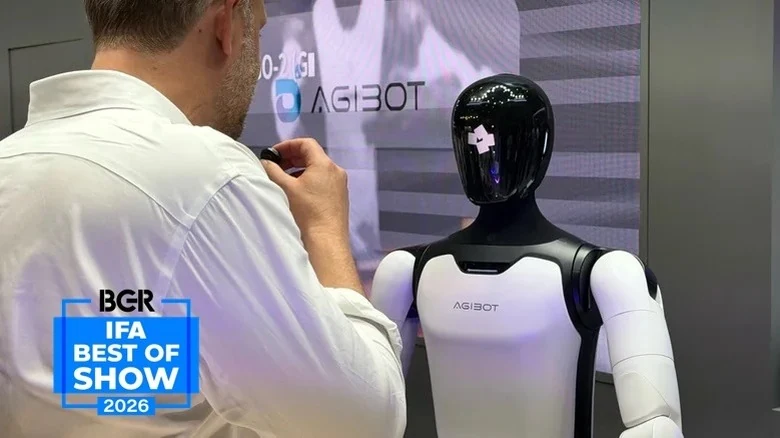
Humanoids Daily reports on an AGIBOT company update and product-page specifications; the reported deployments and capabilities were not independently established. The separate BGR archive photograph shows an exhibition interaction, not the reported customer deployments.
Original synthesis and analysis of the linked public reporting. AI-assisted drafting and translation; reported claims remain attributed to their sources.