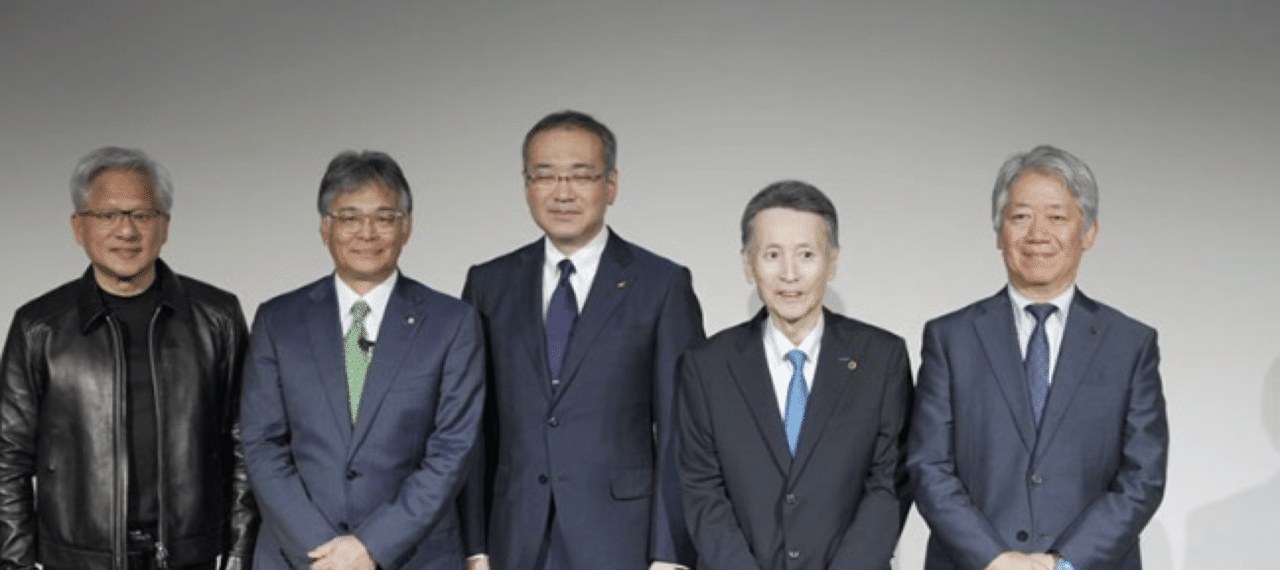
Fujitsu, FANUC, Yaskawa Electric and Kawasaki Heavy Industries have formed a domestic robot alliance to co-develop a cross-vendor humanoid control platform, according to a Fujitsu press release dated July 16, 2026. A first live factory trial is scheduled for September 2026, and pairing four normally independent industrial giants under one control layer is unusual for a market that has historically prized proprietary robot software over shared standards, even among firms that already cooperate on other industrial projects.
The NVIDIA Newsroom details the technical backbone: the alliance standardizes on NVIDIA Cosmos world models and Isaac Sim, so humanoids from each vendor train and get evaluated inside a shared simulation environment before fine-tuning on the physical plant floor. NVIDIA CEO Jensen Huang appeared in Tokyo for the announcement, underscoring how central Japan has become to NVIDIA's physical-AI push.
Reuters frames the move as Japan's answer to two pressures at once: China's manufacturing-scale humanoid push, and the US-centric Optimus and 1X roadmaps built around single-company verticals. Tokyo is betting that systems integration and safety validation, not raw unit output, is where Japan can win.
Taipei Times notes this positioning could make Japan a preferred integration partner for markets wanting humanoid deployments with lower failure tolerance than early Chinese rollouts — a contrast with China's scale-first, refine-later approach, and a plausible fit for Taiwan and Korea's own precision-component ecosystems, both of which already supply precision parts into Japan's existing industrial robot supply chains.
Editor's take — we think the headline is backwards. This is not four companies cooperating out of goodwill; it is four companies admitting none of them alone can build a humanoid software stack fast enough to matter, and NVIDIA is the only party powerful enough to force that admission. Cosmos and Isaac Sim are the actual product here. Fujitsu, FANUC, Yaskawa, and Kawasaki are, in effect, becoming hardware integrators on top of an NVIDIA-owned simulation layer — a dependency Japan has spent decades avoiding in its industrial technology stack, precisely because it prefers to own the software that sits closest to the customer relationship.
If the September trial succeeds, expect at least one additional Japanese industrial name — likely a components or materials supplier rather than a robot maker — to join the alliance by mid-2027, extending the Cosmos-standardized approach further into Japan's supply base. The harder test comes in 2028, when this alliance's humanoids will need service and maintenance networks at real deployment scale; that is where four-company coordination either holds or fractures under commercial pressure, and where old rivalries between these firms' sales organizations could resurface even if the engineering integration itself goes smoothly.
What to watch next is the September 2026 factory trial itself: whether the four vendors' hardware genuinely interoperates under one control layer in a live plant, not just in simulation. A public readout with concrete throughput or defect numbers, rather than a demonstration video, would be the strongest signal the alliance is further along than a press release suggests.
The open risk is coordination failure. Aligning four large, historically independent organizations around shared software timelines is organizationally harder than any single company's roadmap, and delays or scope-narrowing in the first trial would blunt the alliance's claim to represent a unified Japanese approach. A quiet delay announced without explanation would be the clearest early warning sign that internal coordination is the actual bottleneck, not the underlying technology.