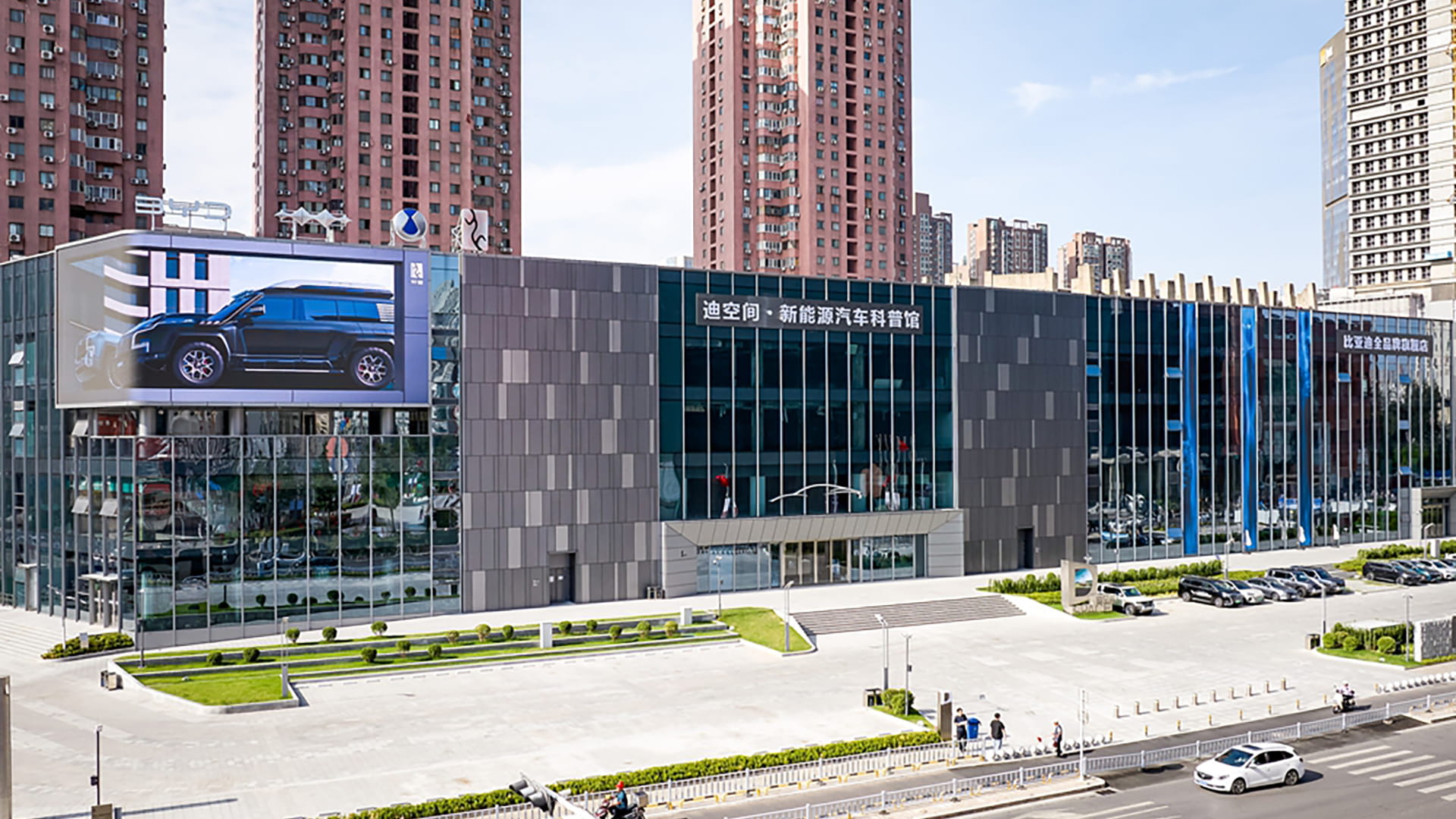
BYD's first humanoid robot, Xiao Di, entered service on August 1, 2026 at the newly opened Di Space Zhengzhou complex, according to SCMP. It is the first time China's largest EV maker has publicly deployed a humanoid outside its own research labs, and hitting the promised August date rather than slipping it suggests BYD wanted a hard public deadline, not a soft pilot announcement.
CnEVPost reports Xiao Di is greeting customers, running showroom tours, and handling light logistics, not the factory-line assembly work Tesla's Optimus and China's AGIBOT G2 have targeted. Retail hospitality is a lower technical bar than manipulation on a moving line, but a higher reputational one: the robot is judged daily by ordinary customers, not engineers on a controlled test floor.
KrASIA describes Di Space as an experiential retail flagship BYD could eventually export to Southeast Asia and Europe alongside its EV showrooms. Putting a humanoid there from day one signals BYD wants Xiao Di understood as a visible consumer product, not an R&D curiosity kept from customers — a template other Chinese manufacturers with retail networks across APAC could copy quickly.
As Yahoo Finance frames it, the subtext is direct pressure on Tesla's Optimus timeline, which keeps slipping toward factory and household chores. BYD instead picked a use case it could ship immediately, with lower safety exposure since the robot never touches a production line — a smaller ambition executed on a real deadline, against a bigger ambition still mostly in demo form.
Editor's take — the actual story here is not the robot, it is the balance sheet behind it. BYD does not need Xiao Di to work perfectly; it needs the world to see that a company already manufacturing batteries, motors, and chips at automotive scale is now willing to put a humanoid in front of paying customers on a fixed date. We think that confidence signal is aimed less at consumers and more at every Japanese and Korean OEM watching from the sidelines, telling them BYD believes its manufacturing base transfers to robotics faster than theirs does. It is also a message to Chinese peers: the EV playbook of vertical integration plus aggressive public deadlines is being re-run in a new category, and whoever hesitates cedes first-mover framing in the domestic press.
Over the next 18 months, expect BYD to expand Xiao Di to additional Di Space sites in China before attempting any export market, using each new site as a low-stakes reliability trial rather than a single high-stakes launch. By 2027, we expect BYD's actuator and control-silicon sourcing decisions — build in-house versus buy from ROBOTIS-style suppliers — to become the real signal of intent, because that choice, not the showroom footage, determines whether BYD becomes a humanoid component supplier to other Chinese brands the way it became a battery supplier to rivals such as Toyota. If BYD starts selling actuators externally before 2028, treat that as confirmation the humanoid unit is a platform play, not a marketing exercise.
What to watch next is whether BYD extends Xiao Di beyond Zhengzhou within the next two quarters. A multi-city rollout in that window would confirm BYD treats retail hospitality as a real product line rather than a press event.
The open risk is durability under unscripted conditions. Showrooms are unpredictable in ways scripted demos are not, and one embarrassing public malfunction in front of paying customers would undercut the consumer-facing bet BYD is making on Xiao Di.