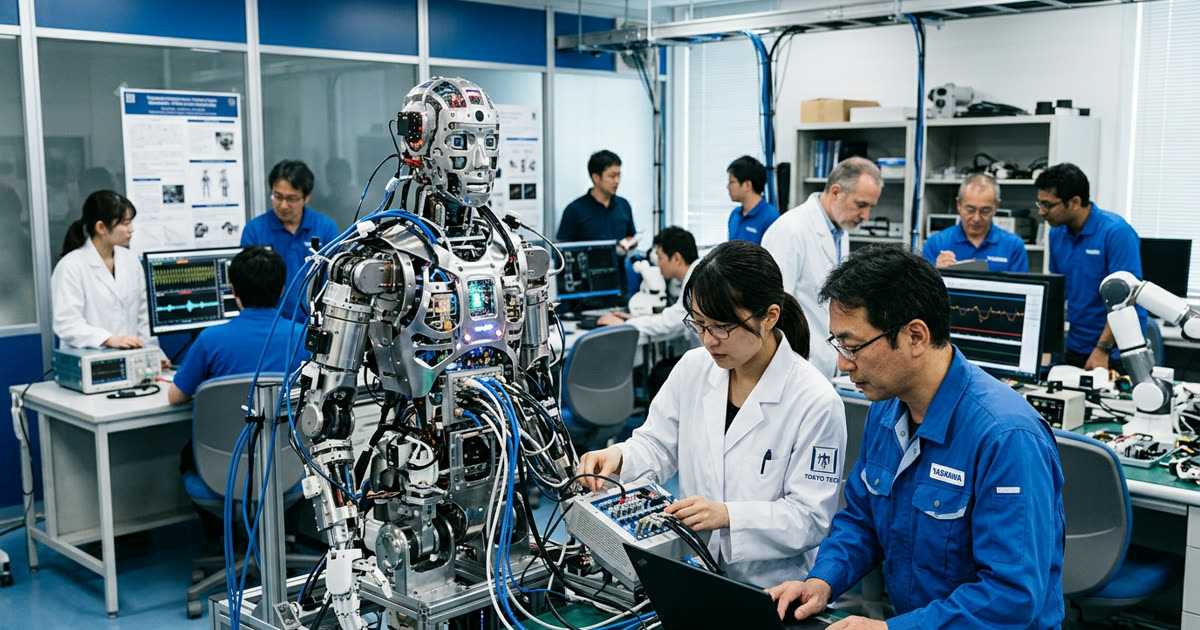
Mitsubishi Electric and the Chiba Institute of Technology signed a three-year research collaboration agreement on May 27, 2026, targeting the development of homegrown Japanese physical AI for humanoid and industrial robotics applications. Reported by Humanoids Daily, the pact formalizes a joint research program that will run dedicated labs at both institutions, with shared IP ownership and a commitment to publishing technical benchmarks that can inform the broader Japanese robotics industry. The agreement also includes provisions for graduate researcher exchanges and joint patent applications.
Mitsubishi Electric brings to the collaboration its extensive industrial automation experience — Mitsubishi Electric is one of Japan's largest factory automation providers, with deep roots in servo systems, programmable logic controllers, and industrial vision — along with hardware testbeds, proprietary sensor systems, and a global customer network across manufacturing verticals. Chiba Institute of Technology, one of Japan's leading technical universities with a strong robotics faculty, contributes research expertise, graduate researcher pipelines, and prior work on manipulation, physical simulation, and perception that forms a mature foundation for the partnership.
What 'Physical AI' Means in This Context
Physical AI refers to AI systems that understand and act on the physical world — perception, force estimation, contact modeling, and generalized manipulation — as opposed to digital-only AI systems focused on language or image generation. For humanoid and industrial robots, physical AI is the software layer that determines whether a robot can reliably grasp novel objects, adapt to unexpected surface variations, or respond to physical perturbations in real time without human intervention. The Mitsubishi–Chiba partnership specifically targets real-time inference for manipulation tasks and the development of physics-accurate simulation environments for training robot policies that transfer reliably to real hardware.
Japan's Sovereign AI Calculus
The partnership is part of a visible and accelerating pattern in Japan's industrial policy: pairing established electronics and automation companies with university research labs to develop AI capabilities that are not structurally dependent on U.S. or Chinese platform providers. This reflects a concern shared across APAC that physical AI infrastructure developed and owned by foreign companies represents a long-term strategic risk for domestic manufacturers who are integrated into critical supply chains. By funding joint research programs with shared IP obligations, Japan is attempting to build a domestic physical AI commons that multiple companies can commercialize.
For Mitsubishi Electric, the partnership signals a strategic evolution: the company is best known for factory automation hardware, but the Chiba collaboration suggests it is investing seriously in the AI software layer that will differentiate next-generation systems in a market where hardware is rapidly commoditizing. If the three-year program produces deployable physical AI modules, Mitsubishi Electric could integrate them into its existing factory automation product lines — providing a distribution and customer relationship advantage that no academic spinout or pure-software startup can replicate.