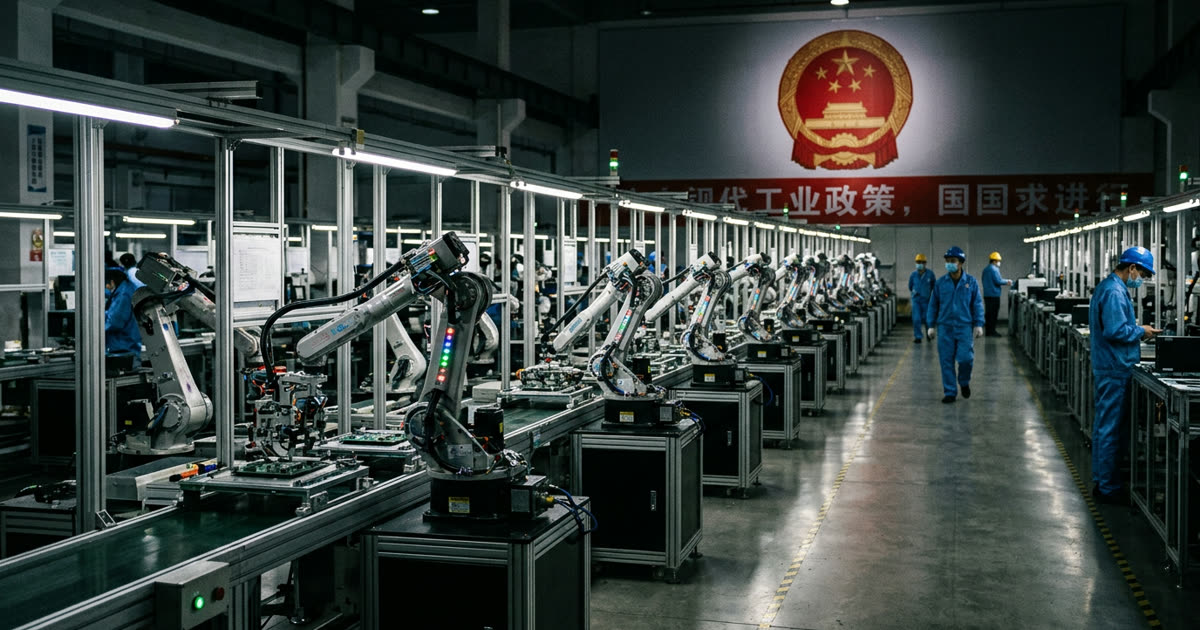
China has taken its boldest step yet in the humanoid robotics race. According to Caixin Global, the Ministry of Industry and Information Technology (MIIT) and the State-owned Assets Supervision and Administration Commission (SASAC) have jointly issued a directive calling for 10,000 humanoid robots in active commercial use by the end of 2026 — a target that would represent a near-vertical ramp in global humanoid deployments. The policy signals a decisive shift from R&D-stage investment to demand-side industrial policy.
The directive, published on June 10, 2026, instructs state-owned enterprises and key industrial players to prioritize humanoid integration across three core verticals: manufacturing assembly lines, logistics and warehousing, and commercial services. The policy is backed by procurement guidance and subsidies channeled through MIIT and coordinated via SASAC. Procurement timelines and per-unit subsidy bands are expected to be published in accompanying implementation guidance within 90 days.
Why This Mandate Is Unprecedented
No other government has publicly set a binding near-term commercial deployment target at this scale. Most national robotics roadmaps focus on R&D milestones or lab-validation benchmarks. China's approach is different: it is using the weight of state procurement — through SASAC's network of central state-owned enterprises — to create immediate, guaranteed demand that private manufacturers can plan production around. This removes the chicken-and-egg problem that has stalled commercialization in other markets. Domestic leaders positioned to capture the bulk of these orders include Unitree Robotics, UBTech, and AgiBot, all of which have production-ready or near-production platforms with demonstrated factory performance.
What Comes Next for China's Humanoid Supply Chain
Meeting 10,000 units by December 2026 requires a compressed timeline for component supply chains — particularly for harmonic drive actuators, force-torque sensors, and onboard edge-inference chips. Several Chinese OEMs have been signaling production readiness since late 2025, and the directive is widely interpreted as the trigger event that accelerates volume orders. Analysts expect a cascade of deployment announcements from SASAC-affiliated manufacturers in the weeks following the directive's publication. Supply chain stress is most likely to appear in precision joint actuators, where domestic alternatives to imported components are still maturing.
The broader implication for APAC is significant: if China reaches even 60–70% of its stated target, it will have demonstrated a replicable state-led model for humanoid adoption that other governments in the region are likely to benchmark against. The directive positions humanoid robots not as a future-of-work experiment, but as a present-tense industrial infrastructure decision. For global investors tracking the humanoid sector, China's mandate represents the single most concrete demand signal the industry has received to date — one that will accelerate capital deployment from manufacturers and component suppliers worldwide.