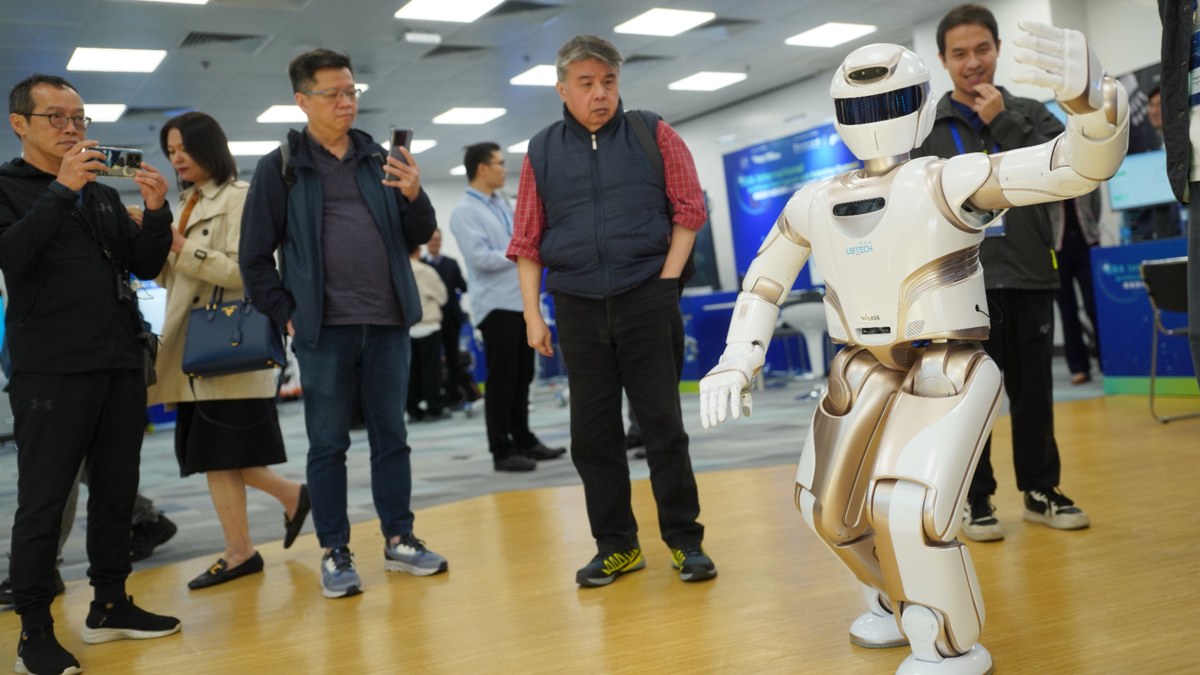
For two days in mid-April 2026, the Hong Kong Convention and Exhibition Centre became a gallery of what the commercial humanoid robot market looks like when it moves beyond the factory gate. Two simultaneous robot exhibitions drew attendees from across the Greater Bay Area, with a combined showcase of more than 100 humanoid and social robots. The breadth of demonstrations — from backflips and sand painting to security patrols and multilingual conversation — offered one of the clearest pictures yet of how diverse the application landscape for humanoid platforms has become in the span of just two years.
AGIBOT's X2 Ultra: Compact, Conversational, and Commercially Ready
The centerpiece of the exhibition was AGIBOT's X2 Ultra, a compact humanoid robot that attracted the longest queues on the show floor. Unlike many humanoid demonstrations that emphasize raw locomotion or industrial dexterity, the X2 Ultra's signature capability was social interaction: it sang performances and held fluid conversations in both Mandarin and English, adjusting register and tone to match its interlocutors. AGIBOT has positioned the X2 Ultra squarely in the service and hospitality market, where language capability and approachable physical form are primary requirements. The robot's compact stature makes it practical for indoor environments without the ceiling-height constraints that challenge some full-size humanoids.
Chinese Social Robots Already in Museums and Government Buildings
Perhaps the most commercially significant data point to emerge from the Hong Kong exhibitions came not from any live demonstration, but from a sales figure. Shenzhen-based DX Intech Technology reported that it has already sold more than 400 social robots, which are now deployed in operational roles at museums and government buildings, primarily providing visitor guidance and information services. This is not a pilot program — it is a revenue-generating installed base. The fact that Chinese social robots with realistic humanoid faces are already embedded in institutional settings across mainland China and are now being showcased in Hong Kong marks a meaningful transition from prototype status to commercial infrastructure.
The Demonstration Spectrum
The variety of demonstrations on display in Hong Kong reflected the industry's deliberate effort to expand perception of what humanoid robots can do beyond the narrow industrial use cases that tend to dominate Western coverage. Robots executed backflips — a crowd-pleasing capability that doubles as a proof of dynamic balance control. Others performed intricate sand painting, demonstrating the fine motor precision increasingly achievable through advanced actuator technology. Security demonstration scenarios showed robots patrolling spaces, recognizing faces, and alerting on anomalies. Taken together, these performances illustrated a vertical market map that includes entertainment, arts, public safety, and cultural engagement alongside manufacturing and logistics.
Hong Kong as a Strategic Gateway Market
The choice of Hong Kong as a showcase venue carries strategic logic. The city serves as a regulatory and reputational bridge between mainland China's manufacturing ecosystem and international buyers, particularly those in Southeast Asia and the Middle East, who are evaluating Chinese humanoid platforms but require demonstrations in an environment with international legal frameworks and multilingual capabilities. Chinese manufacturers understand this. Hosting exhibitions in Hong Kong, and ensuring their robots can perform convincingly in English as well as Mandarin, is a deliberate market-development move. For the global humanoid market, the April Hong Kong exhibitions provided evidence that China's social robot sector is not just prototyping for the future — it is operating at commercial scale today.