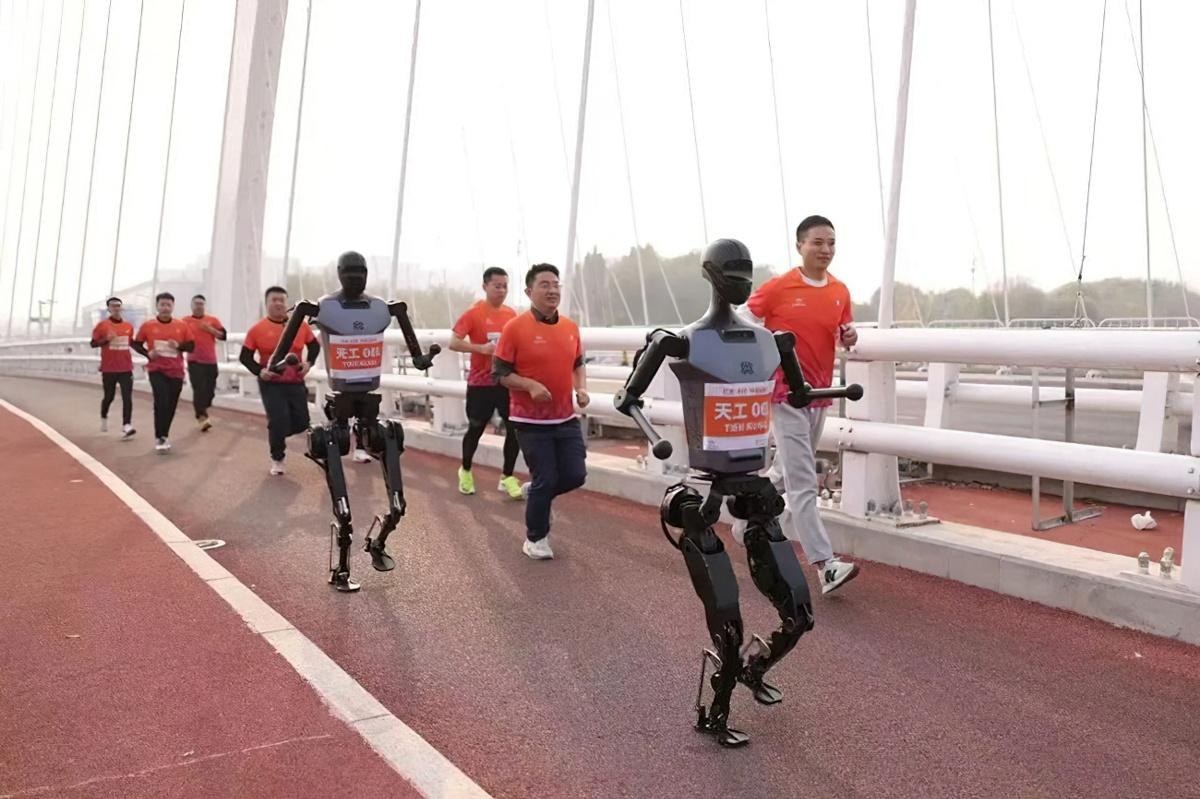
On April 19, 2026, a humanoid robot painted bright red crossed the finish line of Beijing's E-Town Humanoid Robot Half-Marathon in 50 minutes and 26 seconds — a time that would have shattered the human world record of 57 minutes 20 seconds, held by Uganda's Jacob Kiplimo. Honor's robot, nicknamed 'Lightning,' stands 5 feet 5 inches tall and uses liquid-cooling technology in its legs to manage the thermal load of sustained high-speed locomotion. That a smartphone brand's robot can now outpace humanity's fastest distance runners is not a stunt; it is a precise engineering statement about where the field stands in 2026.
A Race That Grew Fivefold in One Year
The scale of the event itself tells a story of explosive ecosystem growth. In 2025, 20 teams competed in the inaugural edition. This April, 105 teams lined up at the starting gate in Yizhuang District — including five international squads — representing every tier of the Chinese humanoid robot industry, from heavily funded unicorns to university research labs. The 21.0975-kilometer course was deliberately punishing: eight continuous elevation changes and sharp turns designed to stress-test navigation algorithms and dynamic balance under fatigue conditions. These are not the controlled laboratory corridors in which most bipedal robots are typically evaluated. Running a half-marathon course is a proxy test for real-world deployment readiness, and the results were revealing.
Honor Claims the Podium Entirely
Honor did not just win — the company secured first, second, and third place outright. The company, best known as a consumer smartphone manufacturer spun off from Huawei, has evidently made a serious commitment to humanoid robotics at the hardware level. Lightning's liquid-cooled leg design addresses one of the most persistent failure modes in high-exertion bipedal locomotion: thermal throttling of actuators under sustained load. By engineering around this constraint, Honor produced a robot capable of maintaining competitive pace across the full race distance without degradation. The prize for finishing in the top positions included contracts worth more than one million yuan (approximately USD 146,500), making the financial incentive for participation concrete.
Autonomy as the Real Benchmark
Beyond the podium results, the statistic that carries the most weight for the industry is autonomy. Forty percent of the competing robots completed the course entirely under their own control, without any human intervention or remote guidance. The remaining 60 percent required varying degrees of operator input, from occasional corrections to active teleoperation on difficult sections. The trajectory from 2025 to 2026 suggests that full autonomy in unstructured outdoor environments — long considered one of the defining hard problems of bipedal robotics — is approaching a tipping point. Twelve thousand human runners competed on an adjacent course simultaneously, providing a vivid real-world backdrop against which the robots' capabilities could be measured.
Beijing as the World's Proving Ground
The E-Town Half-Marathon is more than a spectacle. It is a deliberate policy tool deployed by Beijing's municipal government to accelerate the humanoid robot industry. Yizhuang, the district where the race was held, is also home to a major cluster of robotics and autonomous vehicle companies backed by state investment. Staging a half-marathon that doubles as an open benchmark test — with prize money, media coverage, and procurement contracts attached — compresses the development cycle in ways that academic competitions cannot. For the global humanoid industry, Beijing in April 2026 established a new performance baseline and, in doing so, raised the bar for every team developing bipedal platforms anywhere in the world.