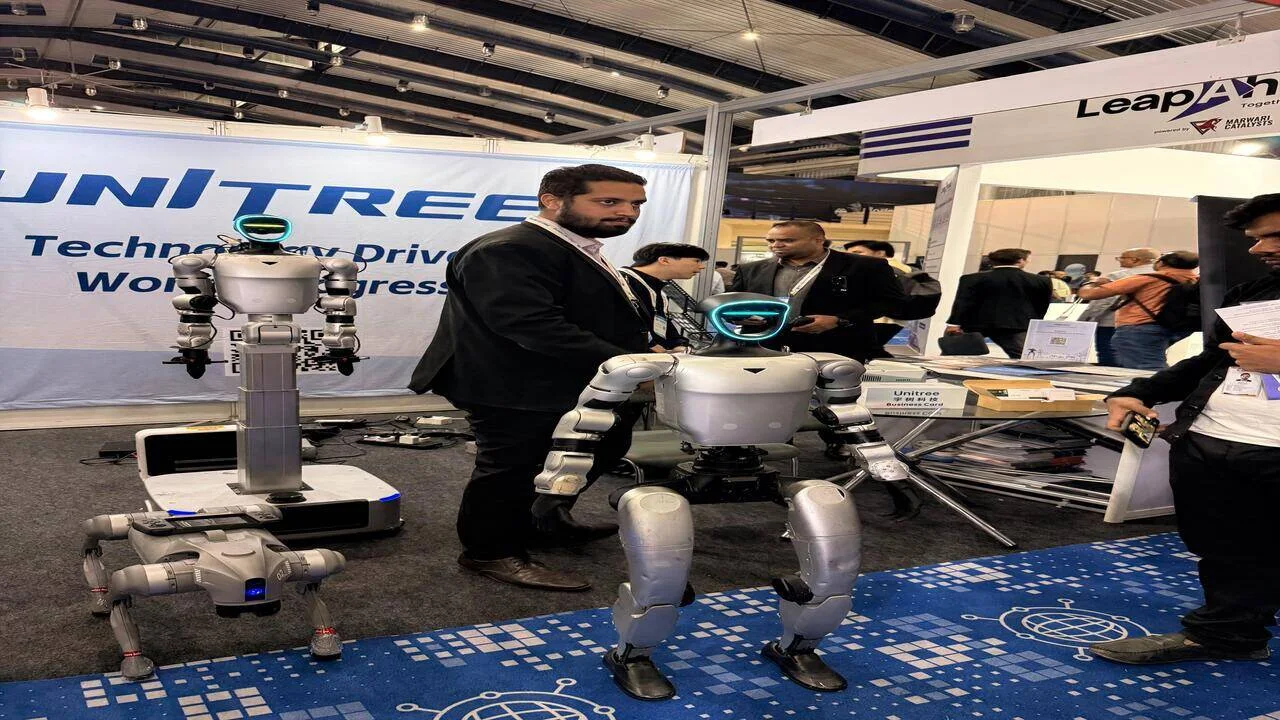
What did Unitree and General Autonomy show in Bengaluru?
At Bengaluru Tech Summit, Unitree reported about 50 humanoids sold in India without identifying the buyers. Local developer General Autonomy presented its TAARA prototype. Sources
A dedicated pavilion for physical AI
The 29th Bengaluru Tech Summit ran from November 17 to 19 at the Bangalore International Exhibition Centre under the theme "AI & Beyond." Organised by the Karnataka government, it featured an AI and Robotics Pavilion of about 50,000 square feet with around 101 showcases, co-curated by Bharat1.ai.
The pavilion included a humanoid lab demo zone, a humanoid meet-and-greet area and robot races.
Imported humanoids and local challengers
At Unitree's stall, a representative told The Times of India that about 50 humanoid units had been sold in India, without naming buyers. The G1 is priced between Rs 20 lakh and Rs 60 lakh in India depending on configuration, and can handle objects of about 2 to 3 kg.
Bengaluru startup General Autonomy showed TAARA, a humanoid designed to work in human environments, handle tools and climb stairs. An engineer told ETV Bharat it can carry up to 40 kg on its back and lift up to 10 kg with its hands. The company's PARAM quadruped won the summit's robot race.
Editorial analysis: India's demand is real but still early
The reported sales suggest early demand for a research platform; the customers were not identified. CNA notes funding constraints and dependence on imported components among Indian startups.
For India, the question is whether domestic makers can move from prototypes to reliable products before imported platforms become the default for research and pilot projects.
Editorial perspective: A spare part may decide which robot an Indian lab buys
The G1 and TAARA drew attention for different reasons, but a buyer cannot choose between them by comparing a quoted carrying capacity with a reported sales tally. For a lab planning a semester of experiments, a more useful question is what happens when a hand fails halfway through. An inexpensive machine that waits weeks for a part could cost a research team its entire experiment window.
Indian developers do not necessarily have to beat an imported platform on every specification. An opportunity worth testing is whether they can provide a replacement, an engineer and usable documentation sooner. Ask competing suppliers to quote a repair and demonstrate a restart, not just a lift. That would give local support an observable value without assuming that the buyers of the reported G1 units were labs.