What do Korea’s KIMM humanoid robots learn in Daejeon?
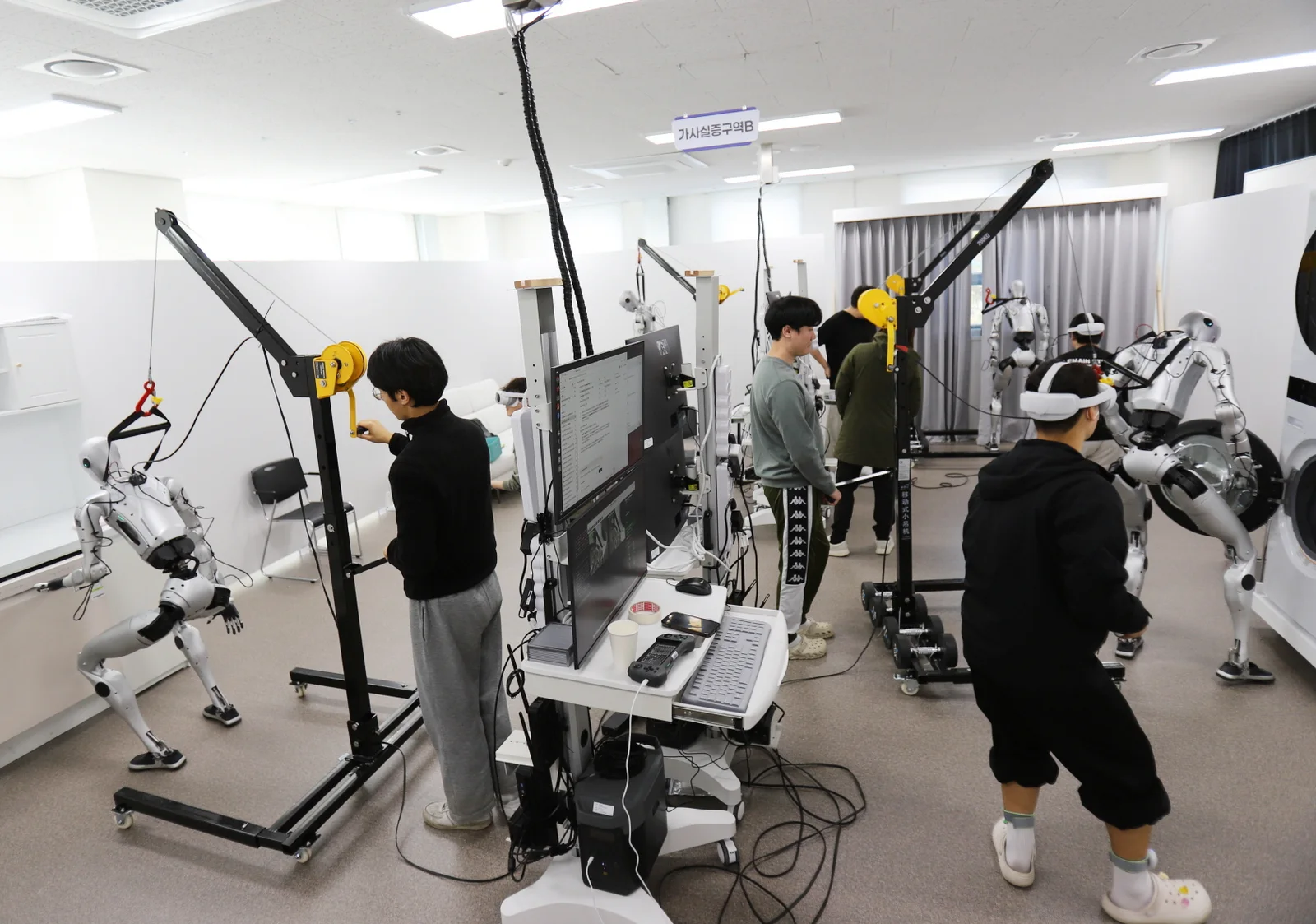
At KIMM’s Daejeon facility, trainers remotely guide 12 humanoids through household and vehicle tasks. The recordings are training data, not evidence that the robots perform those jobs independently. Sources
A dedicated site for collecting humanoid training data
The Korea Institute of Machinery and Materials (KIMM) opened its AI Humanoid Data Factory in Daejeon on November 3, working with the Electronics and Telecommunications Research Institute (ETRI). The facility occupies the second and fifth floors of KIMM's L3 Building.
Twelve humanoid robots are operated remotely by human trainers, who demonstrate tasks so the robots' movements and sensor readings can be recorded as training data.
Everyday tasks, repeated until they become data
KIMM's demonstrations included opening a refrigerator, handling laundry, working around a sofa and pressing buttons and pulling levers inside a vehicle. The aim is to collect high-quality data across household and mobility settings rather than a single factory task.
The institute describes an iterative loop: collect data, train models, deploy them back on robots and collect again. The project is linked to Korea's K-Humanoid standard platform effort and is led by Dr. Chan Hun Park.
Editorial analysis: Data capacity is becoming national infrastructure
Twelve robots is modest next to China's largest training grounds, but the signal matters: Korea is treating physical-AI data as shared research infrastructure rather than leaving each company to build its own.
The test will be whether the data is published in usable formats, how much of it transfers to different robot bodies, and whether Korean manufacturers actually train on it. KIMM has not disclosed hourly data volumes or access terms.
Editorial perspective: What a refrigerator handle can teach Korea’s next robot
Opening a refrigerator makes a useful test precisely because two refrigerators can look alike but behave differently. Change the seal or the handle and a movement that worked yesterday may no longer open the door. A demonstration that records only the successful pull misses the most interesting moment: how the operator notices resistance and changes the grip.
We would judge the Daejeon facility by what a team outside KIMM can do with its recordings. Give that team a different robot and an unfamiliar refrigerator, and compare its results with and without the shared data. If it needs fewer demonstrations of its own, the facility has delivered something a national program ought to buy: less duplicated work across labs.