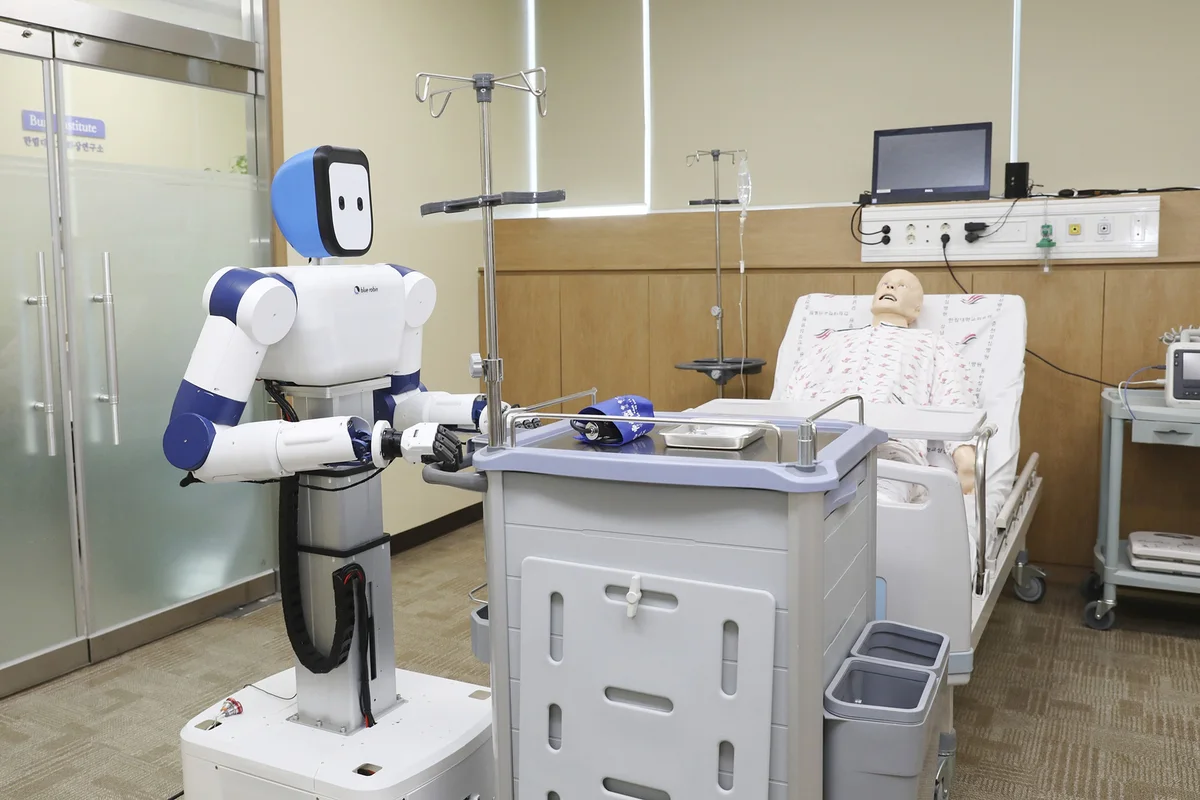
Did Hallym test a humanoid robot on a live hospital ward?
No. Hallym and BlueRobin tested a wheeled prototype in a simulated ward for supply deliveries and equipment transport, not direct patient care. Sources
A basic operational test in a replica ward
Hallym University Sacred Heart Hospital said on November 20 that it had tested the navigation and item-delivery functions of a hospital-specific humanoid robot, developed with robotics firm BlueRobin, at the Hallym Simulation Center of Hallym University Medical Center.
The work is part of a Ministry of Trade, Industry and Energy robot technology project the two organisations have run since 2025 to develop humanoids for hospital and home environments. The hospital defines the tasks and verifies results against clinical standards.
Tight corridors, supplies and mobile equipment
The robot is an early research model with a wheeled base and a humanlike upper body. The team checked how it moved through tight spaces, delivered medical supplies and patient gowns, and transported mobile medical equipment, paying attention to space limits, route interference and handling precision.
Data from the test will feed into the robot's detailed specifications and the development of its hardware and control software.
Editorial analysis: Hospitals want support work first
Lee Mi-yeon, head of the command center at Hallym University Medical Center, said the goal is to use robots first in supporting roles that reduce staff walking and routine tasks, not in direct patient care. That is the realistic entry point for healthcare humanoids.
Before wider use, hospitals will need evidence on infection control, safe movement around patients and visitors, and integration with existing logistics systems. Park Sung-ho of H-CORE said the simulation center will also train staff to work with robots.
Editorial perspective: The useful unit is a nurse’s uninterrupted minute
A robot can cover the distance between a supply room and a ward without saving a nurse any time. Someone may still have to load the gown, confirm its destination, meet the robot and put it away. If those steps interrupt different people, a shorter walk can mean a more fragmented shift. That is why a replica ward is a sensible place to redesign the handoff, not just to test the wheels.
Before moving into a live ward, we would rehearse an urgent interruption: a bed needs the corridor while the robot is carrying routine supplies. Who can move it aside, and can the delivery resume without calling the nurse back? Compare the staff minutes actually freed with a cart delivery. The result would say more about workload than metres travelled.