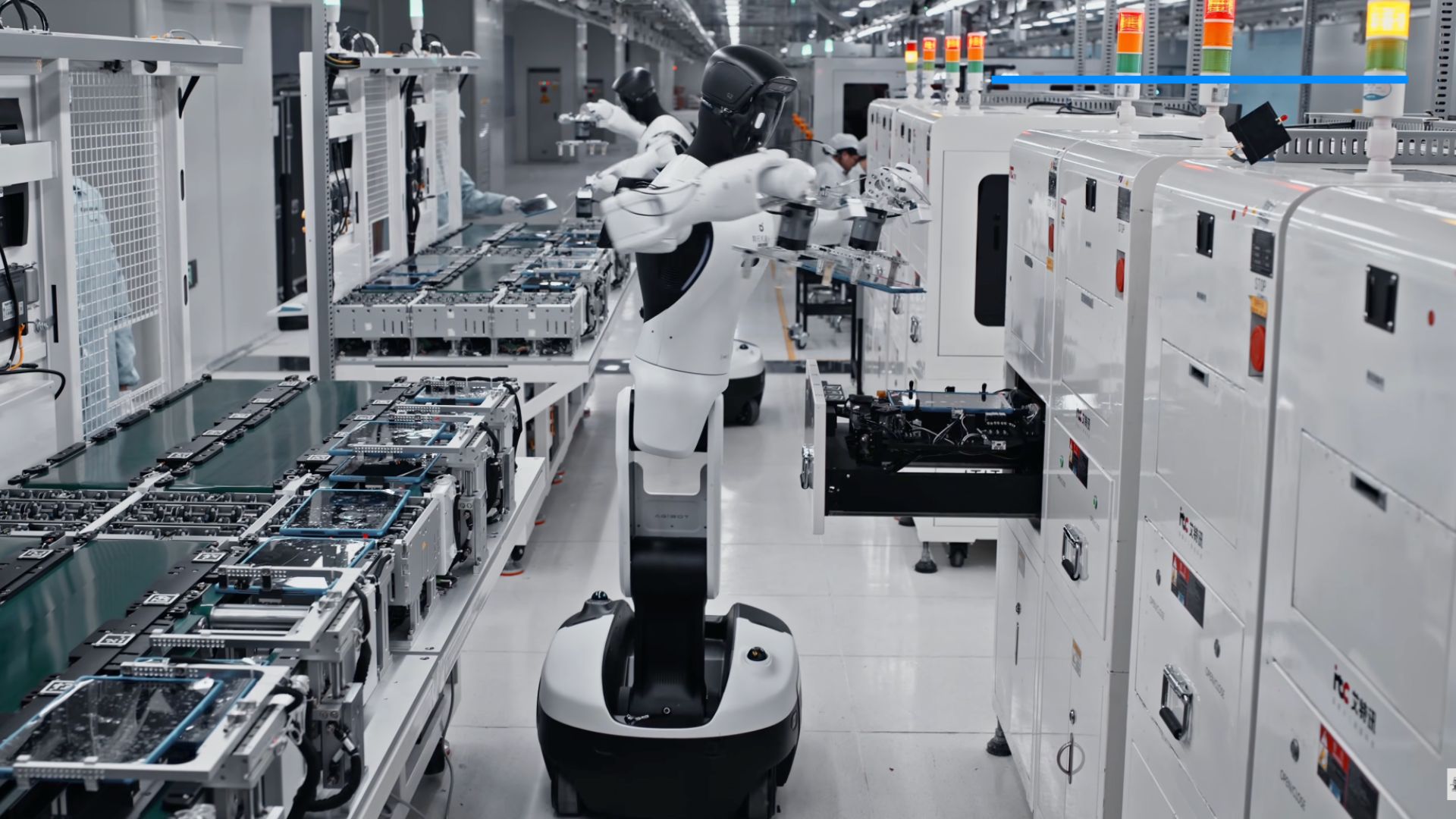
Chinese garment factories, with their dense concentration of production lines and willing manufacturing partners, are becoming a preferred proving ground for humanoid dexterity, and state broadcaster coverage this week made the case visually. According to People's Daily, humanoids were shown on garment lines grabbing, aligning, and passing pieces of cloth between stations — work that looks simple on video but is mechanically unforgiving.
Fabric handling is a fundamentally different and considerably harder problem from the rigid-object picking most warehouse robots have already solved: cloth deforms, wrinkles unpredictably, and generates variable friction against grippers, all far harder to model than the fixed geometry of a box. Garment lines function as a genuine dexterity benchmark rather than a staged demonstration.
Interesting Engineering frames this as a cycle-time contest against experienced textile manufacturing workers: if a humanoid cannot sustain acceptable throughput over a full shift, the general-purpose narrative weakens regardless of how polished the demo footage looks, and garment factories are a particularly unforgiving proving ground because defects are visible immediately, not after months of use.
For APAC textile hubs in Vietnam, Bangladesh, and Cambodia, the implication is strategic: these economies compete substantially on labor-cost advantage in garment and apparel manufacturing, and if humanoid dexterity crosses a genuine deployment threshold in China first, global sourcing could shift toward automated Chinese production before the rest of the region has comparable robotic capability, undercutting a labor-cost advantage that Southeast Asian manufacturing hubs have relied on for decades and forcing a strategic rethink of where new garment capacity gets sited.
Editor's take — we think the labor-cost framing understates the real threat. It is not that Chinese humanoids make garment workers in Hanoi or Dhaka redundant overnight; it is that reshoring pressure that has been building in Western apparel supply chains for a decade now has a mechanical justification, not just a political one. A brand that wanted to bring production closer to its home market for tariff or ESG reasons finally has a labor-substitution argument that does not depend on wage arbitrage at all, which changes the politics of reshoring from a cost story into an automation-capability story.
If cycle times on deformable-material tasks reach parity with skilled human operators by 2028, expect the first visible move to be automated micro-factories inside China serving nearby domestic and regional brands, not an immediate wave of garment-sector job losses in Southeast Asia — the transition will show up first in where new capacity gets built, not in existing factories shutting down. Sourcing executives should watch capital-expenditure announcements from Chinese apparel groups more closely than layoff figures out of Vietnam or Bangladesh over the next two years.
What to watch next is whether these trials move from pilot lines to full shift-length deployments with published defect and throughput rates — endurance over an eight-hour shift, not a five-minute demo, is what will decide the category, and any published defect-rate comparison against human operators would be the clearest signal yet.
The open risk is that dexterity demonstrations and full-line economic viability remain different things for longer than expected; a robot that grabs fabric reliably in a monitored trial is not the same as one that does so at acceptable defect rates across an entire shift without human intervention, and that gap is where most automation projects historically stall, sometimes for years longer than initial demonstrations suggest.