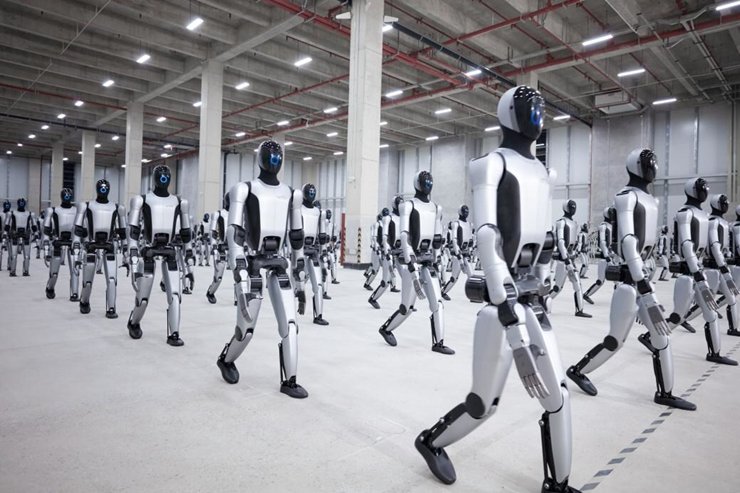
China's Ministry of Industry and Information Technology, giving vendors and regional governments a hard number to plan around rather than vague optimism about the category's trajectory, publicly framed 2026 as the year national humanoid output will exceed 100,000 units, according to CGTN. Coming from a deputy director rather than a company marketing channel, the number reads as a policy anchor, not a corporate sales projection.
That distinction is why the signal matters commercially: buyers in logistics, manufacturing, and public services can plan procurement around a state-set supply floor rather than one-off vendor pilots, lowering perceived execution risk substantially and unlocking multi-year budget commitments that would not clear internal approval against a single company's roadmap alone.
SCMP reports this sits inside a broader nationwide program fast-tracking humanoid robots and embodied AI, meaning the 100,000-unit figure is coordinated industrial policy spanning financing, local pilots, and standards work, not an isolated forecast, and the same playbook China previously used to scale solar panels and electric vehicles into global leadership, sectors where early state-backed capacity targets eventually became durable competitive advantages.
For Japan, Korea, and Southeast Asia, the pressure is to move up the value chain rather than match volume: component leadership, safety certification, and specialized software stacks become the realistic differentiators, since none of these markets can plausibly out-produce the target set by China's Ministry of Industry and Information Technology on raw unit count within the same timeframe, leaving specialization as the only realistic strategic lane left open to them.
Editor's take — the number that matters is not 100,000, it is who gets to define what counts as a unit. We suspect this figure blends genuinely deployed robots with units sitting in showrooms, demo halls, and government-relations photo ops, the same inflation that dogged early solar-panel and EV production statistics in China a decade ago. Treat the milestone as a floor for manufacturing capacity, not a floor for economically useful robots, until deployment data says otherwise, and treat every province that cites the figure without its own local deployment numbers as borrowing credibility rather than adding to it.
By late 2027, we expect the more consequential number to be utilization rate, not output — the share of shipped units still in active service after twelve months. If that ratio stays meaningfully below the levels Chinese solar and EV manufacturing eventually achieved after their own early overcapacity phases, expect provincial governments to face real pressure to subsidize deployment directly, not just production, to keep the 100,000-unit narrative credible. Either the utilization data eventually becomes public and strong, cementing the milestone, or it stays unpublished indefinitely, which is itself an answer.
What to watch next is whether MIIT or provincial governments publish deployment or utilization data alongside future output figures — that data, not the headline number, will show whether this is a genuine industrial milestone or simply a manufacturing statistic dressed up as one, and its absence by early 2027 would itself be a meaningful and telling signal.
The remaining uncertainty is quality distribution. Reaching 100,000 units manufactured does not mean 100,000 units usefully deployed, and a large gap between shipped and productively operating robots would undercut the milestone's significance entirely, turning what could be a genuine policy triumph into a cautionary tale about manufacturing statistics detached from real-world use, the same pattern skeptics warned about in earlier Chinese industrial-policy pushes.