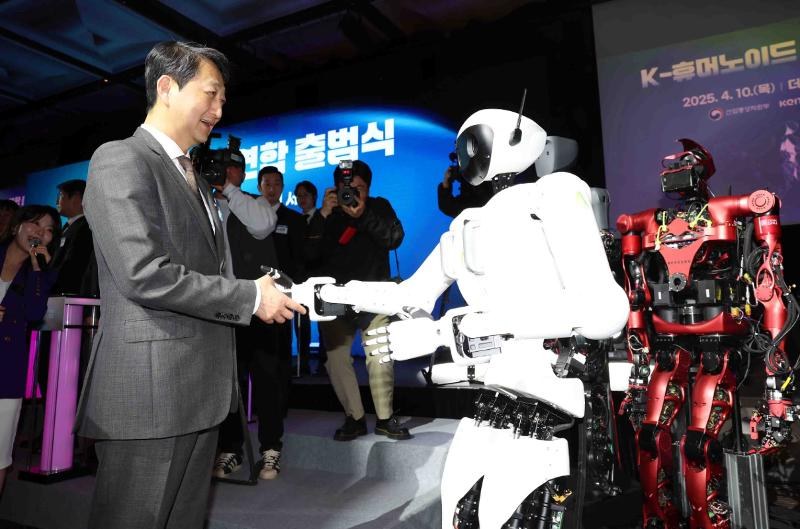
South Korea's Korea Institute of Machinery and Materials rarely generates headlines outside of engineering research circles. Its April 8, 2026 publication of Mechanical Technology Policy No. 122 — titled 'The First Year of Commercialization of Humanoid Robots' — changed that. The document, framed as a national strategic assessment rather than a departmental research report, serves as the clearest articulation yet of how Seoul intends to position South Korea in a humanoid robot industry that China is currently dominating with approximately 90 percent of global shipments.
The KAIROS Mandate and the K-Humanoid Alliance
At the center of Korea's humanoid strategy is a program to develop an autonomous AI humanoid prototype, codenamed KAIROS, with a target completion date of April 2027. The program is backed by KRW 220.8 billion (approximately USD 160 million) in committed investment through 2030 — a figure that, while modest compared with Chinese state spending on humanoid robotics, reflects a concentrated national bet on a specific technical objective rather than diffuse sector subsidies. The institutional vehicle for this effort is the newly formed K-Humanoid Alliance, comprising ten companies including Neuromeka, Tomorrow Robotics, and Blue Robin. The alliance structure reflects Korea's broader industrial policy tradition of mobilizing smaller specialized firms around a national champion objective.
Samsung and Hyundai: The Corporate Anchors
Beyond the K-Humanoid Alliance, the policy document highlights the roles of Korea's two largest industrial conglomerates in the humanoid ecosystem. Hyundai Motor Group, which acquired Boston Dynamics in 2021, is reportedly building a factory capable of producing 30,000 humanoid robots per year by 2028 — a production ambition that would place it in the same order of magnitude as the current Chinese leaders. Samsung Electronics, meanwhile, is securing its humanoid manufacturing position through its investment in Rainbow Robotics, the domestic robotics firm that has been one of Korea's most technically advanced bipedal robot developers. The alignment of these two corporate anchors with a national policy framework gives the Korean strategy a combination of private capital and institutional direction that the K-Humanoid Alliance alone could not provide.
AeiROBOT's Global Signal
One of the more striking data points in Korea's humanoid ecosystem is the international validation already received by AeiROBOT, a smaller Korean firm whose Alice 4 humanoid was selected by NVIDIA CEO Jensen Huang as a notable showcase at CES 2026. Jensen Huang's personal endorsements carry significant weight in the robotics industry, given NVIDIA's central role in providing the AI computing substrate on which most humanoid robots now depend. That a Korean company earned that spotlight — ahead of many better-funded Chinese and American competitors — suggests that Korea's technical talent in bipedal robotics and AI integration should not be underestimated simply because its production volumes are currently lower.
A Race Against Established Leads
Korea's strategic challenge is stark: it is declaring the first year of commercialization at a moment when China has already shipped tens of thousands of units and is racing toward six-figure annual production. The policy framework correctly identifies that Korea's competitive advantage cannot be volume-based in the near term, and instead positions the country around AI capability, manufacturing precision, and integration with global supply chains that already rely on Korean component technology. Whether KAIROS delivers on schedule in April 2027 will be the first real test of whether Korea's structured national approach can compress the gap with China's market-led ecosystem on a timeline that matters commercially.