Has LG CLOiD received KIRIA humanoid safety certification?
LG plans to seek pilot certification for robots including CLOiD. Its agreement with KIRIA concerns developing the assessment system, not a completed safety approval. Sources
An agreement on safety, reliability and usability
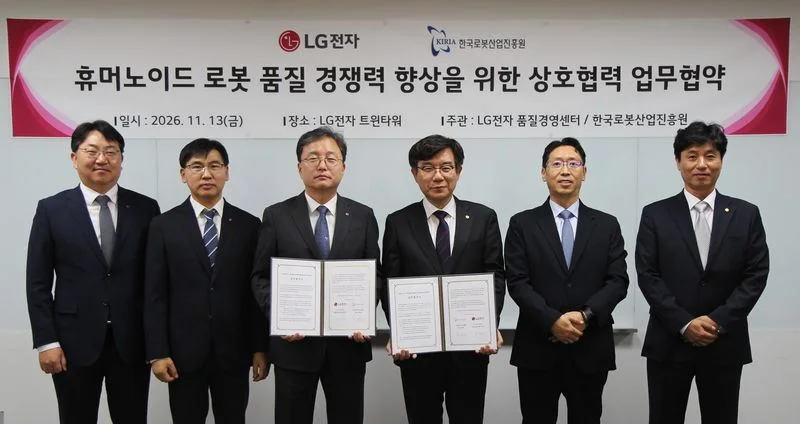
LG Electronics said on November 16 that it had signed a memorandum of understanding on November 13 with the Korea Institute for Robot Industry Advancement (KIRIA) at LG Twin Towers in Seoul. The ceremony was attended by KIRIA president Jo Young-hoon and Kim Chang-min, executive vice president and head of LG's Quality Management Center.
LG will help build the assessment system for KIRIA's Humanoid Robot Safety Certification Center and contribute to related national and international standards.
Pilot certification for CLOiD and a bipedal robot next
The company plans to pursue domestic pilot safety certification for humanoid robots including LG CLOiD, using the process to verify the technology objectively and prepare for commercialization. Development experience will feed into the assessment criteria, which will then be used to test the robots.
LG is developing a bipedal robot based on NVIDIA's reference platform and is targeting an unveiling in the first quarter of 2027. It says safety, reliability and usability will be checked from the early stages, because humanoids will share homes and workplaces with people.
Editorial analysis: Certification is becoming a competitive advantage
Helping write the test before launch gives LG an early understanding of what regulators and buyers will ask for. It also gives Korea a reference process at a time when standards for human-shared robots are still unsettled.
Observers should watch whether KIRIA's criteria are published, whether they align with ISO work on mobile and humanoid robots, and whether rival makers can certify on the same terms.
Editorial perspective: A safety label should tell a buyer when it stops applying
Suppose a robot passes its assessment, then its maker changes the software that decides when an arm should stop. The housing and model name may be identical, but the behaviour beside a person could be different. For buyers, the practical value of KIRIA’s pilot will depend partly on whether they can tell which configuration was tested and which changes trigger another assessment.
LG’s participation gives the centre access to a developer’s experience. The safeguard we would look for is a result that another manufacturer can reproduce and challenge. Publishing the test conditions, software version and limits of a pass would do more for trust than a broad claim that a product is safe. A pilot application is an opportunity to establish that practice, not evidence that a robot has already passed.