Who can enter Korea’s Next-X Humanoid Challenge?
Korea plans separate tracks for teams building their own platforms and teams developing software on Korean robots. Buying and modifying a complete foreign humanoid does not qualify. Sources
A competition with 53.5 billion won behind it
South Korea's Ministry of Science and ICT held a preliminary briefing on November 24 in Seoul, with the National Research Council of Science and Technology, the National Research Foundation of Korea and the Korea Robotics Society, on the Next-X Humanoid Challenge.
The government plans to invest 53.5 billion won over five years from 2027: 23.5 billion won for a competition phase in 2027 and 2028, and 30 billion won for further development support from 2029 to 2031.
How teams will be chosen and judged
Applications are expected to open for one month from mid-February 2027. About 10 teams will be selected in April after document and video reviews and site visits, each receiving 1 billion to 3 billion won in R&D funding over two years, plus access to government-secured GPUs, physical AI data and simulation environments.
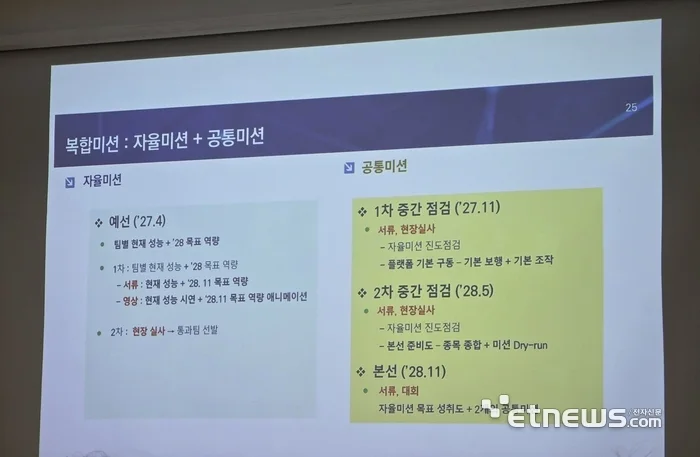
Teams will compete in a Championship track for those developing their own humanoid platforms, and an Open Platform track for AI and software on commercially available Korean robots. Bipedal and wheeled designs are both allowed, but teams cannot enter by buying and modifying complete foreign humanoids, including Chinese ones. Interim reviews are set for November 2027 and May 2028, with a final in November 2028 that includes shared missions such as supporting independent living and taking over hazardous tasks.
Editorial analysis: Korea wants control of the core technology
The ban on modified foreign robots is the clearest statement yet that Korea wants domestic control over mechanical design, control software and integration, not just applications built on imported hardware.
The budget is modest per team, so the challenge works best as a filter that directs later investment. Its success will depend on fair, transparent missions and whether winners go on to commercial production.
Editorial perspective: Two competition tracks offer Korea a useful experiment
Imagine a team succeeds at a household task on an off-the-shelf Korean robot while a team building its own body struggles. That result could mean the first team wrote better software. It could also mean its gripper happened to fit the object. A leaderboard alone would not tell the ministry whether the next round of public funding should go toward control software, a new hand or better integration.
The two tracks give organizers a chance to learn from that ambiguity. Alongside the winning run, publish the assistance allowed, the equipment used and where unsuccessful attempts broke down. Then try the same task with a slightly different object. Even a team that does not win could leave Korean suppliers with a precise, reusable description of a problem worth solving.