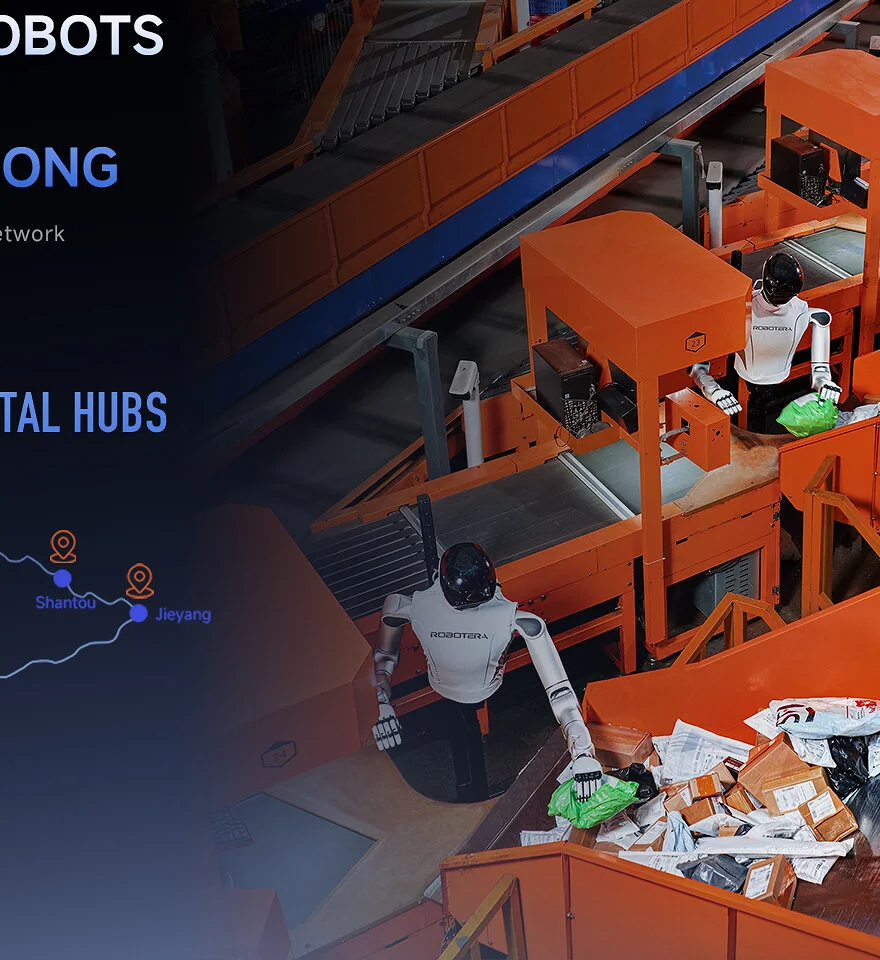
Where is China Post using ROBOTERA M7 logistics robots?
ROBOTERA says its M7 robots feed parcels into sorting lines at 11 Guangdong postal hubs. Its reported induction rate is not the same as end-to-end delivery throughput. Sources
From one pilot to 11 postal hubs
ROBOTERA (Xingdong Jiyuan) said its M7 embodied-AI logistics robots are now operating at 11 China Post hubs in eight Guangdong cities: Guangzhou, Shenzhen, Dongguan, Jiangmen, Shantou, Shanwei, Jieyang and Heyuan. The rollout is run with China Post's Guangdong branch.
The deployment grew out of a pilot at the Guangzhou Postal District Center that began in March 2026. Guangdong is China's largest province by express parcel volume.
What the robots do, and what is not disclosed
The robots handle the repetitive work of feeding parcels into sorting lines and cover surges during shopping peaks. ROBOTERA says they average more than 1,500 parcel inductions per hour in routine operation, which it compares with experienced human sorters. They can reject irregular items, adjust speed to avoid jams and use the company's five-finger dexterous hand without changes to existing lines.
The company also reports a batch deployment of 45 robots at China Post's Hangzhou postal center and several hundred units delivered to logistics customers in total. The Guangdong release does not give a robot count, uptime figures or pricing.
Editorial analysis: Parcel induction is a real job, with real metrics
Feeding parcels is narrow, repetitive and easy to measure, which makes it one of the more credible early jobs for humanoids. Spreading across eight cities suggests the work has moved beyond a showcase site.
Buyers should ask for independent throughput data, error and jam rates, and the staffing needed per robot. Those numbers will decide whether humanoids beat conventional automation in postal sorting.
Editorial perspective: Follow the parcel that the robot rejects
Rejecting an irregular parcel can be the right decision: one awkward package should not stop a sorting line. But the parcel does not disappear. Someone still has to take it to a place where it can be handled. A fast robot can therefore shift a bottleneck a few metres downstream while looking excellent on its own counter.
For another postal operator considering the M7, we would ask for a whole-shift comparison on the same mix of parcels. Count pieces that reach the correct next stage, including the rejected ones, and include the labour needed to clear them. That comparison would reveal when a dexterous hand is worth fitting to an existing line and when a simpler feeder plus a staffed exception lane does the job better.