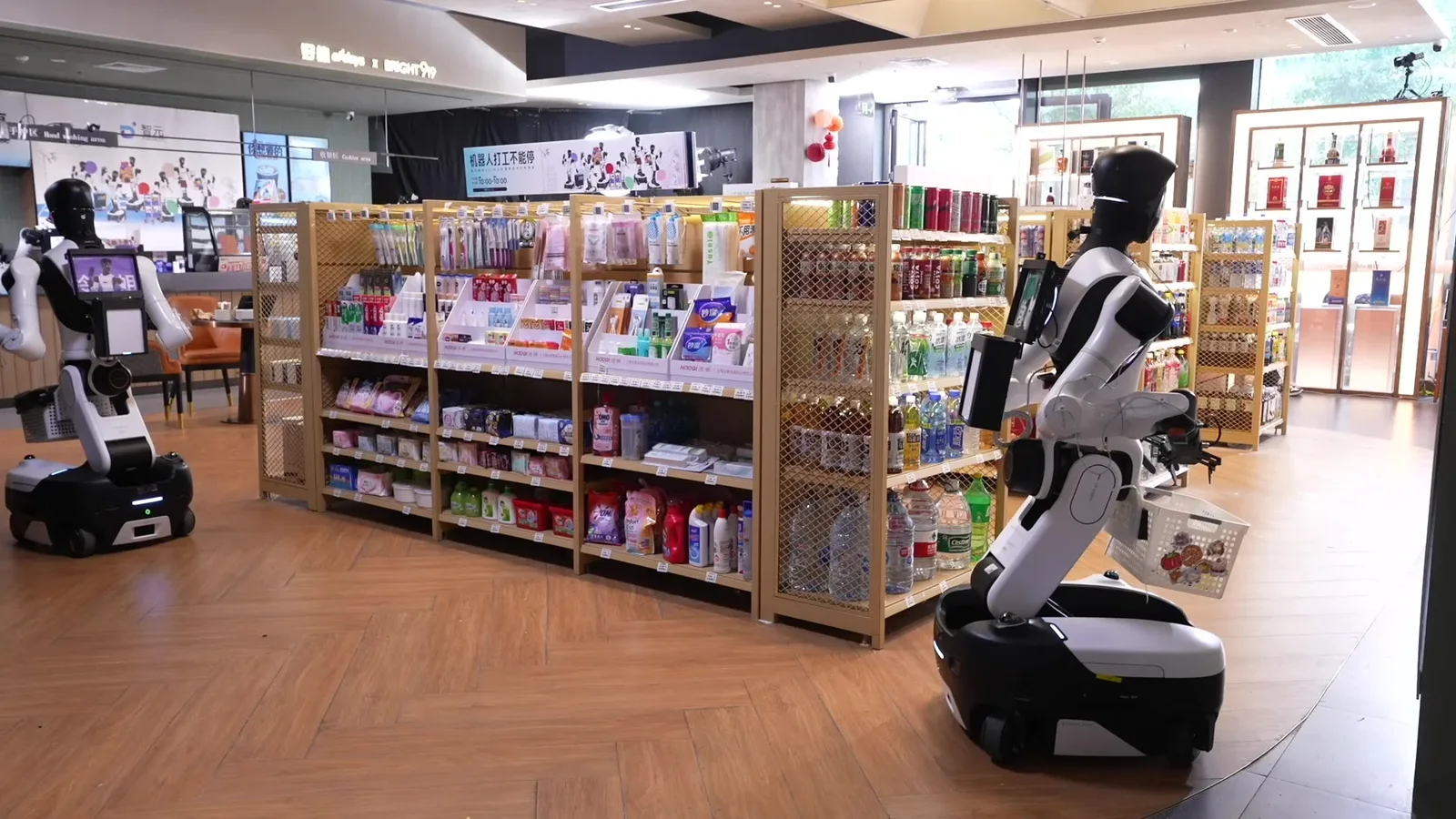
How did AGIBOT G2 robots perform in the Shanghai store trial?
AGIBOT reported 1,730 tasks in 24 hours. Four of its six G2 robots passed its assessment; the results do not establish that the store operated without human help. Sources
A livestreamed shift in a store with paying customers
AGIBOT ran its "Robots Never Clock Out" trial from 10 a.m. on November 2 to 10 a.m. on November 3 in an operating convenience store in Shanghai's Xuhui District. Six G2 wheeled humanoids were assigned to customer assistance, shelf inspection and restocking, coffee, checkout and hot food, and cleaning.
The trial covered the lunch rush, evening peak, overnight operations and the breakfast rush, and the company says the livestream drew more than two million viewers.
1,730 tasks, and an honest scorecard
AGIBOT reports 1,730 completed tasks: 683 customer-service interactions, 369 product pickups and deliveries, 147 coffee orders, 126 breakfast servings, 277 shelf inspection and restocking tasks and 128 table-cleaning tasks.
Only four of the six robots passed the final assessment. Media reports say the cleaning robot and one shelf-patrol unit struggled; one account notes the cleaning robot left its route after meeting a full trash can. The two units were placed in an observation group.
Editorial analysis: Continuity is the real retail test
Publishing a failure rate makes this more useful than a polished demo. Retail work is about staying reliable through crowds, clutter and night shifts, not completing one impressive task.
Reports do not say whether the robots needed charging breaks, maintenance or human help during the shift. Retailers should ask for intervention counts, staffing behind the robots and cost per hour before treating this as a staffing model.
Editorial perspective: The full bin is the most useful result of the store trial
A full bin changes the job. The cleaner can no longer finish simply by following its route; someone has to empty the bin, choose another one or take the cleaner out of service. For a store manager, the important question is who notices first. If the cashier has to leave a queue to investigate, a completed cleaning round can still make the shift harder to run.
We would repeat the trial during comparable lunch rushes, with and without the G2s. Log interruptions to staff, minutes until service resumes, and how long customers wait. Coffee orders and shelf checks are both worth counting, but adding them together cannot tell a manager whether bringing robots back tomorrow will make the queue shorter.