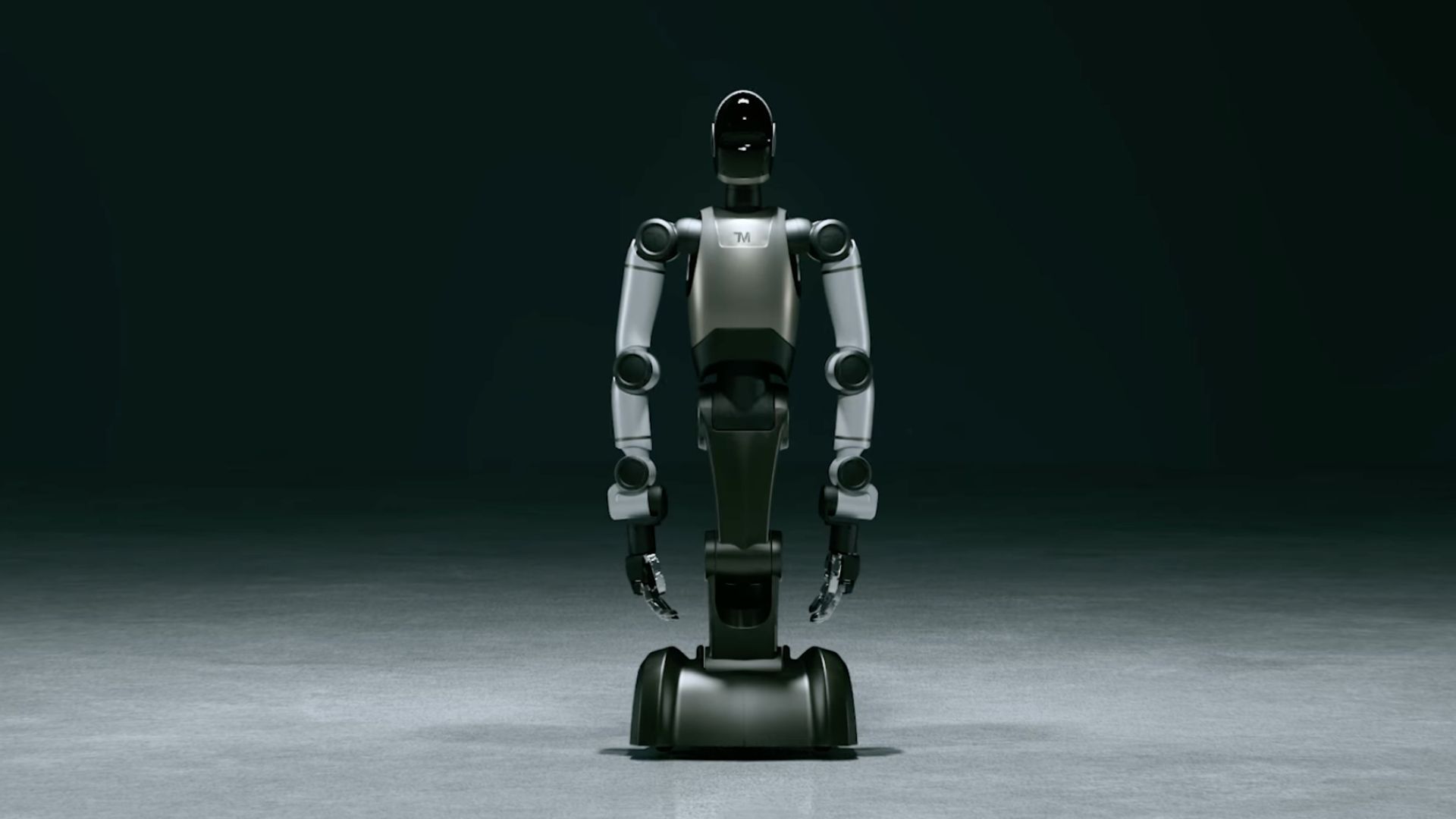
Taiwan's Techman Robot — best known as one of the world's leading collaborative robot makers — took the stage at NVIDIA's GPU Technology Conference in San Jose to unveil TM Xplore I, a wheeled humanoid powered by NVIDIA's Jetson Orin platform and trained using Isaac GR00T. The launch marks Taiwan's official entry into the humanoid robot maker category, and signals the island's ambition to move beyond supplying components to building the complete machine.
TM Xplore I: The Platform
The TM Xplore I is a 1.6-metre wheeled humanoid designed for smart factory and warehouse deployment. Its upper body — two 7-DOF arms with Techman's proprietary vision-integrated hand modules — mounts on a four-wheeled mobile base optimised for flat-surface navigation, precise docking, and low energy consumption during stationary tasks.
The robot runs NVIDIA's Jetson Orin system-on-module for onboard real-time AI inference, giving it the compute capacity to process high-resolution visual data, run vision-language-action (VLA) models, and execute motion planning simultaneously without offloading to cloud infrastructure. This is a significant engineering choice: it means TM Xplore I can operate in factory environments with limited or no internet connectivity — a hard requirement for many semiconductor and defence supply chain customers.
Techman has integrated its vision system — already proven across 40,000 deployed collaborative robots worldwide — into the Xplore I's head unit, enabling the same colour-and-depth object recognition that makes its cobots popular for electronics assembly. The company claims sub-millimetre repeatability on pick-and-place operations, positioning the robot for precision tasks its competitors cannot match at this price point.
The VLA Model and Learning Architecture
At the heart of TM Xplore I is a vision-language-action model trained using a combination of human teleoperation demonstrations, simulated environments built in NVIDIA Omniverse, and synthetic data generated from digital twins of Techman's customer facilities. The model allows operators to give the robot instructions in natural language — "sort the blue PCBs by size and stack them on tray 3" — and have it execute the task without explicit programming.
Techman demonstrated this capability live at GTC, with the robot successfully assembling an HDMI cable harness from components scattered randomly on a workbench — a task it had been taught through 45 minutes of teleoperation demonstration two weeks prior. The result drew significant attention from attendees: cable harness assembly is considered one of the hardest dexterous manipulation challenges in industrial robotics, and TM Xplore I completed it with 94% first-attempt success rate in front of the crowd.
Taiwan's Strategic Moment
Techman's launch is the most visible sign yet of a broader strategic shift in Taiwan's technology industry. The island has long supplied the world's humanoid robot supply chain — TSMC fabricates the AI chips, Delta Electronics and TECO supply the servo motors, and dozens of precision component makers provide the harmonic drives and actuators that go into every major humanoid platform. But until Techman's announcement, no Taiwanese company had integrated all those components into a commercially viable complete robot.
The Taiwanese government has been explicit about its ambition to change this. The National Science and Technology Council's NT$20 billion smart robotics programme — approved by the Executive Yuan in 2025 — specifically targets the creation of at least three "complete system" humanoid robot companies in Taiwan by 2028. Techman, with its existing manufacturing scale and global customer relationships, is the strongest early candidate to meet that bar.
Quanta Technology Partnership
TM Xplore I was developed in partnership with Quanta Technology, the R&D arm of Quanta Computer — one of the world's largest laptop and server ODMs. Quanta's involvement brings two things Techman lacked: experience designing products at consumer-electronics volumes, and direct relationships with the hyperscaler and enterprise customers who will be the first large-scale buyers of humanoid robots for data centre and logistics operations.
Quanta's CEO Barry Lam indicated at GTC that the company is evaluating deploying Xplore I units in its own manufacturing facilities in Taiwan as a first customer — a validation step that would give Techman production data before its commercial launch in H2 2026.
Foxconn's Parallel Path
Techman is not the only Taiwanese giant entering the humanoid space. Foxconn — which has partnered with NVIDIA to deploy humanoids at its Houston AI server plant and developed the Nurabot healthcare robot with Kawasaki — is reportedly developing its own bipedal humanoid for Foxconn-internal deployment. The two approaches reflect Taiwan's two paths into the humanoid era: Techman building a commercial platform for external customers, Foxconn developing a captive solution for its own 1.3 million-person global workforce.
Commercialisation Timeline
Techman has confirmed plans to begin commercial sales of the TM Xplore I in H2 2026, following internal validation at Quanta's facilities. Initial pricing has not been disclosed, but Techman's cobot pricing history — ranging from $20,000 to $30,000 for its TM series arms — suggests the Xplore I will be positioned at $45,000–$65,000 fully configured, competitive with Japanese precision humanoids but well below the $100,000+ entry point of Western general-purpose platforms.