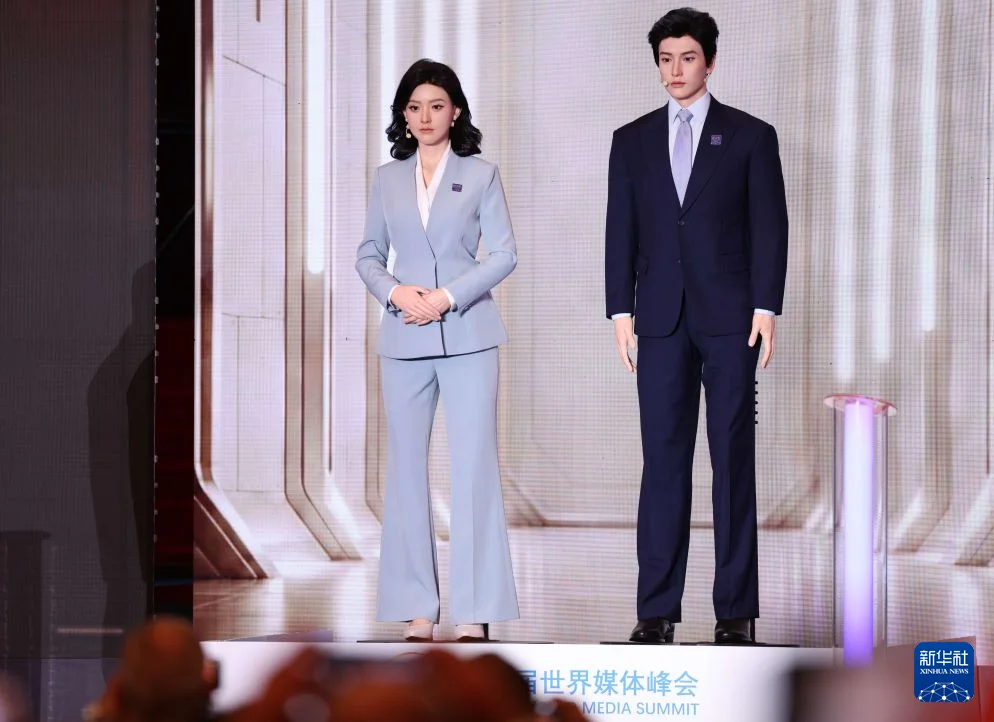
What are Xinhua’s UBTECH humanoid news anchors for?
Xinhua introduced Xinyan and Xinyu as assistants for journalists and public presentations. Their unveiling did not establish that either robot independently reports or verifies news. Sources
Two human-scale anchors launched at the World Media Summit
Xinhua News Agency unveiled two bionic humanoid robot news anchors, the female Xinyan and the male Xinyu, on November 5 at a forum of the 7th World Media Summit in Beijing. Xinhua calls them the world's first bionic humanoid robot news anchors.
The robots are built at a 1:1 human scale. Film director Zhang Yimou designed their appearance, while UBTECH supplied the biomimetic skin, an emotion-focused large model and mass-production capability.
Powered by Xinhua's language corpus
The anchors run on Xinhua Yudian, an AI corpus built by the agency. Planned uses include education bases, public venues, international exchange and, in future, reporting from deep space.
Qian Tong of Xinhua's New Media Center said the robots are meant to assist journalists, not take the spotlight from them. UBTECH chief executive Zhou Jian presented the project as part of the company's push into bionic humanoids.
Editorial analysis: A showcase for bionic faces, not yet a newsroom tool
The launch is best read as a demonstration of UBTECH's realistic-face technology and of China's interest in humanoids as public-facing communicators.
Neither party has disclosed how many units will be built, what tasks the anchors will perform live, or how editorial control and disclosure to viewers will work. Those answers matter more than appearance for any newsroom considering similar systems.
Editorial perspective: A correction is a better newsroom test than a flawless reading
A lifelike presenter can deliver a sentence convincingly whether the sentence is right or wrong. Consider a public exhibition where a visitor asks about a developing story after the prepared introduction ends. Who decides whether the anchor answers from an approved script, acknowledges that the information has changed, or refers the visitor to a journalist? The face cannot settle that editorial question.
Before judging the anchors by how natural they appear, we would ask Xinhua to demonstrate a correction. Show what a visitor hears after an editor withdraws a line, how quickly both anchors stop using it, and whether the audience can identify the responsible newsroom. That would demonstrate a capability a digital screen and a human presenter also have to deliver: accountable speech.