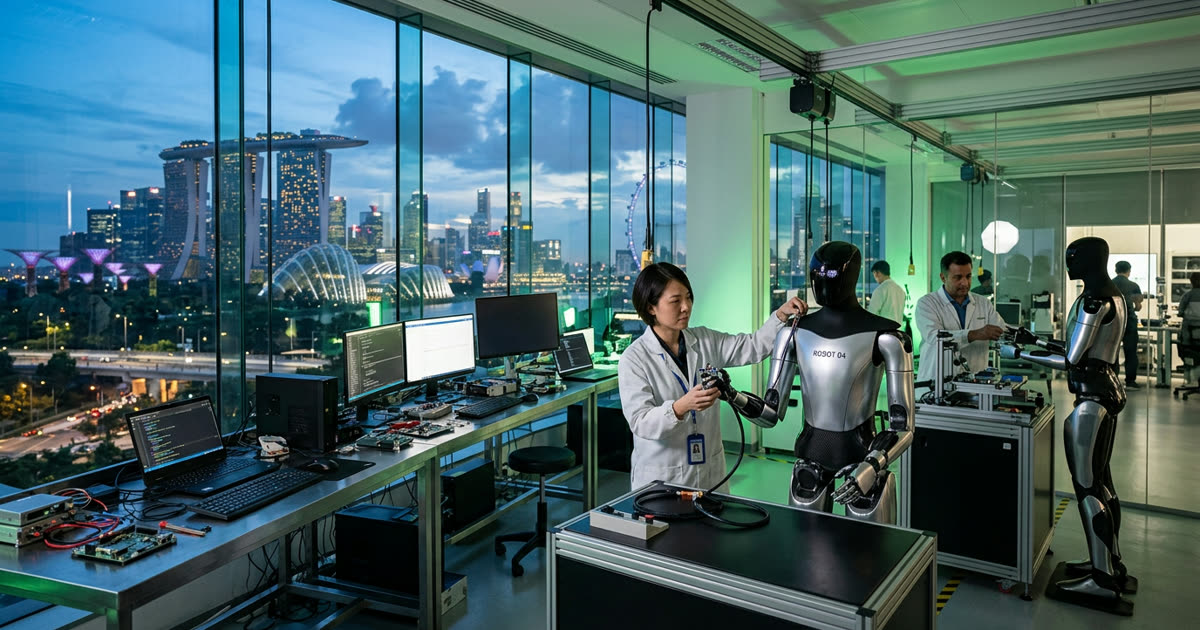
YY Group, a Singapore Exchange-listed company, opened a humanoid robot training laboratory in Singapore on June 4, 2026, powered by NVIDIA hardware and software. According to Storm Media, the lab serves as both a research and development environment and a pre-deployment conditioning facility — where humanoid robots are trained on specific environmental layouts, interaction protocols, and service workflows before being placed in live commercial venues. The facility represents a deliberate investment in deployment quality rather than simply acquiring hardware off the shelf.
The launch was accompanied by the announcement of two active pilot deployments: one in a Singapore shopping mall, where humanoid robots assist visitors with wayfinding, promotional interactions, and basic concierge queries, and a second in a luxury hotel, where they support front-desk and guest services functions including check-in assistance and directional guidance. YY Group confirmed the deployments are live and that YY Group is collecting structured operational performance data and guest reception feedback to inform future iterations.
Why Service Robotics Is a Strategic Bet for Singapore
Singapore faces a structural labor constraint that makes it an unusually receptive market for humanoid service robots. With one of the world's lowest fertility rates, an aging workforce, and chronically tight labor supply in hospitality and retail, the economic case for robotic service staff is more immediate here than in most markets. The Singapore government has actively encouraged automation adoption through the Productivity Solutions Grant and related schemes, giving operators like YY Group a direct financial tailwind for early-stage deployment. Regulatory frameworks for service robots in public spaces are also more developed in Singapore than in most other APAC markets.
The Role of NVIDIA Hardware in the Training Pipeline
YY Group's decision to anchor its training lab around NVIDIA's compute platform — including Jetson-based edge inference hardware and the Isaac robotics software stack — reflects the emerging industry consensus that training infrastructure matters as much as robot hardware. A humanoid robot's performance in a specific venue depends heavily on how well it has been trained on that venue's spatial layout, surface types, lighting conditions, and typical interaction scenarios. Dedicated training labs that replicate real environments before live deployment significantly reduce failure rates once the robot is operating in public-facing settings.
YY Group's dual role — operating both the training lab and the live deployments — gives it a feedback loop that pure hardware vendors lack. Each hour of live deployment generates operational data that flows back into the training pipeline, allowing performance improvement over time. If the mall and hotel pilots demonstrate commercially acceptable guest satisfaction and operational uptime, YY Group will have a replicable deployment model for expansion across Singapore's hospitality and retail sector — and a potential case study for export to other Southeast Asian markets where similar labor dynamics apply.