Asia-Pacific · Analysis
Factories, Warehouses and Hospitals: Humanoid Robot Trends in the Top Three Industries
Manufacturing, logistics and healthcare offer three important windows into humanoid adoption, though their maturity differs sharply. This analysis looks at what is happening in each sector, what results have actually been shown, and what APAC buyers should check before they invest.
5 min read
Why these three industries lead
Humanoid robots make the most sense where buildings, tools and workflows were designed for people and are expensive to redesign for conventional automation. Manufacturing, logistics and healthcare share three conditions: a labour shortage, repetitive or physically demanding tasks, and environments built around the human body. We focus on these three sectors for their practical relevance, not because they form a statistically verified top-three ranking. Healthcare in particular remains more experimental than industrial material handling.
The scale is still modest. The International Federation of Robotics counted about 7,000 full-size humanoids sold worldwide for commercial and professional use in 2025, compared with more than 600,000 conventional industrial robots installed in the same year. Automakers piloting humanoids typically run fewer than ten machines. The trend matters because of its direction, not its current size.
Manufacturing: automakers set the pace
Car factories are the leading test ground. BMW is deploying Figure AI's Figure 03 at its Spartanburg plant in the US to pick parts from unsorted containers and load them into sequencing trolleys, after an earlier Figure 02 pilot that supported production of more than 30,000 BMW X3 vehicles. Hyundai Motor Group is training Boston Dynamics' Atlas at a dedicated application centre in Georgia, plans to deploy it for sequencing at its Metaplant from 2028, and is targeting component assembly by 2030.
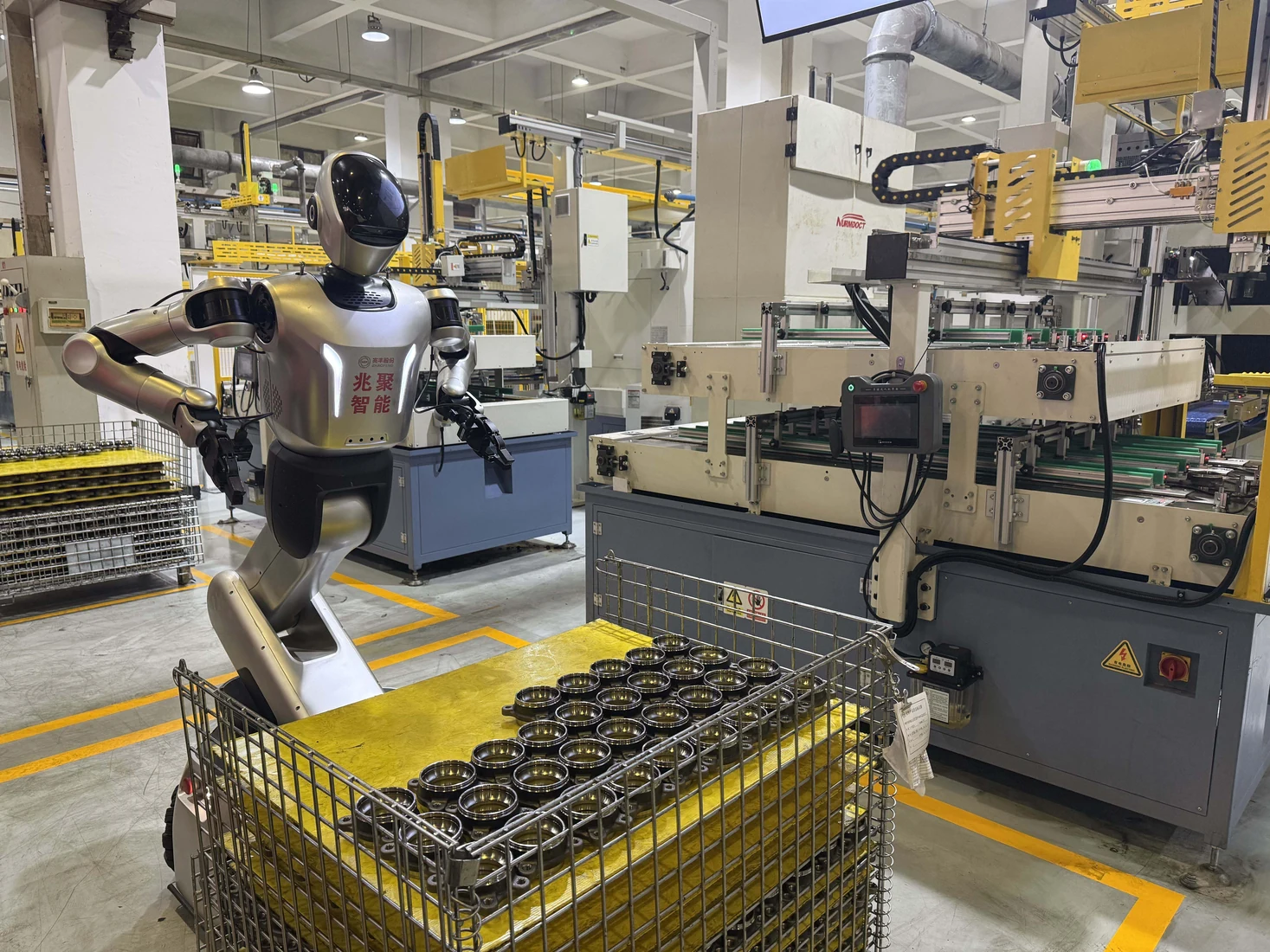
Across Asia, manufacturers are also testing industrial applications. Chinese automakers and suppliers are bringing humanoids into production lines. Leju and Zhaofeng put 15 Kuavo humanoids to work on automotive parts loading. XPENG is preparing production of its IRON humanoid. UBTech opened a factory in Liuzhou with a planned capacity of more than 10,000 humanoids a year. Shanghai aims to have 100,000 humanoids in factories by 2030, and Korea has approved regulatory sandboxes for humanoid trials in semiconductor packaging, car manufacturing and shipbuilding.
The most common tasks are material sequencing, parts loading, inspection support and moving totes between stations. They are simple tasks in structured spaces, so they are the right starting point.
Logistics and warehousing: the first proven workloads
Warehouses gave humanoids their first real commercial jobs. Agility Robotics' Digit has moved more than 100,000 totes at GXO's facility in the US state of Georgia under a robots-as-a-service agreement. In September 2026, Agility unveiled Digit 5, which it says is designed to work close to people without safety cages, with early access planned for the first half of 2027.
In Asia, Rainbow Robotics' RB-Y1 is being piloted in a Coupang fulfilment centre in Korea, and Chinese makers are offering wheeled humanoids for picking, packing and retail restocking. Logistics suits humanoids because the tasks; lifting, carrying, stacking and loading; are repetitive and easy to measure, and warehouses run long shifts where labour is hard to find.
Healthcare and eldercare: assisting, not replacing, clinicians
Healthcare is the most sensitive of the three sectors, and also one of the most important for ageing Asia. In September 2026, Samsung Medical Center in Seoul publicly demonstrated humanoid surgical assistants that hand over and retrieve instruments by voice command and hold endoscopes. In laboratory tests, they grasped five instrument types with 100% success and transferred them with 98.7% success. Clinical trials at four hospitals are planned for 2029, starting with low-risk tasks.
In Japan, startups are testing humanoids in hospitals for visitor guidance, carrying items and clearing dishes, and in nursing homes for patrols, with responses to residents' call buttons planned next. These robots take routine work off nurses and carers so they can focus on patients, which is the realistic model for the coming years.
What results have been shown and what is still missing
Across all three industries, the most important questions are about evidence. Most published results come from the companies themselves, cover short periods or single sites, and rarely include independent tests. Few deployments disclose uptime, intervention rates, task success rates or total cost of ownership. Safety standards are also still being written: the first international standard covering humanoid-style dynamically stable robots, ISO 25785-1, is still at draft stage.
A buyer's checklist for APAC
- Start with one measurable task, such as parts sequencing or tote handling, rather than "general help".
- Ask for data from live operations: hours run, success rate, human interventions and downtime.
- Clarify how much of the work is autonomous and how much depends on remote operators.
- Assess safety in shared spaces and check which standards and risk assessments the vendor follows.
- Model the full cost: integration, training, maintenance, software subscriptions and support.
- Plan for workers: explain the change, retrain staff to supervise robots, and involve unions or employee representatives early.
Manufacturing and logistics are likely to remain prominent deployment areas in 2027, while healthcare will require slower, closely supervised validation. The winners will not be the companies with the most impressive demos, but those that can show reliable, repeatable work in real conditions.