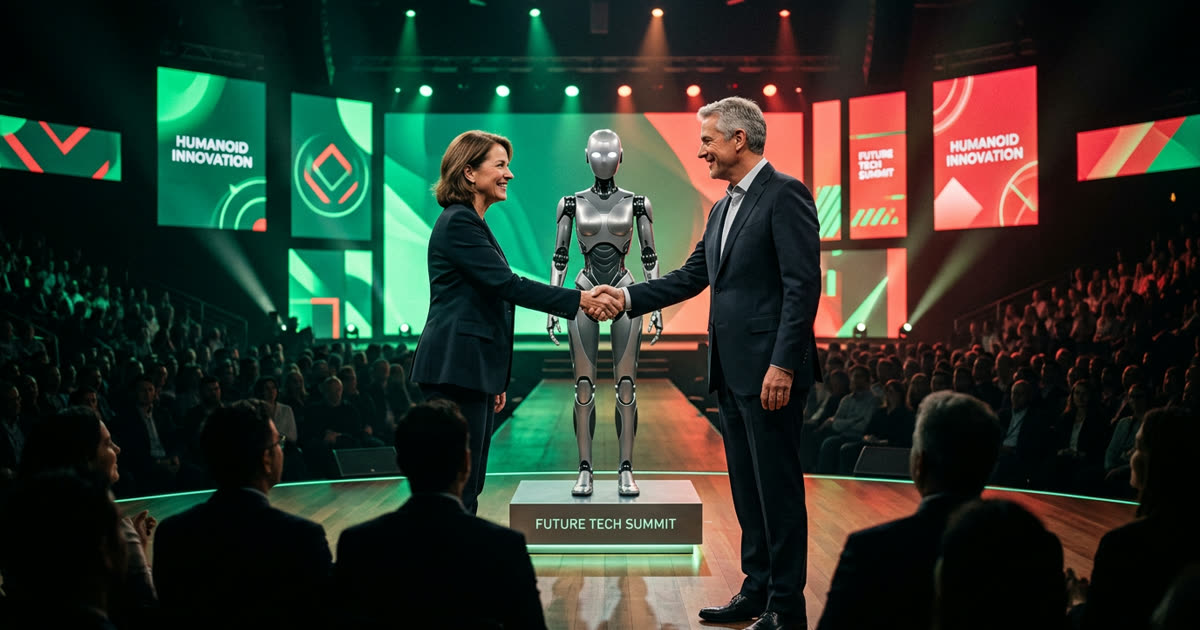
NVIDIA CEO Jensen Huang arrived in Seoul on June 8, 2026, and departed with one of the week's most consequential humanoid robotics announcements: a strategic partnership between NVIDIA and LG Electronics spanning humanoid robot AI development and AI data center infrastructure. According to The Silicon Review, the alliance pairs NVIDIA's Isaac GR00T physical AI framework with LG's hardware development, sensor manufacturing, and large-scale production capabilities. Both companies described the partnership as multi-year and covering joint engineering collaboration rather than a simple reseller arrangement.
The partnership was framed as a two-track collaboration. On the humanoid side, LG will integrate NVIDIA's Isaac GR00T foundation model platform — which provides pre-trained robot policies, simulation environments, and real-to-sim-to-real data pipelines — into its CLOiD humanoid robot development program. On the infrastructure side, LG Electronics will contribute advanced display and component technology to next-generation AI data center builds that NVIDIA is enabling across the Korean market. The combination of LG's manufacturing depth and NVIDIA's AI software ecosystem creates a joint value proposition neither company could offer independently.
Isaac GR00T: Why It Matters for LG
Isaac GR00T is NVIDIA's attempt to create a universal foundation model for robot manipulation and mobility — a pre-trained AI backbone that robot developers can fine-tune on their own hardware and data rather than training robot AI from scratch. For LG, integrating GR00T means the company's CLOiD data factory output can be used to fine-tune a world-class foundation model rather than funding a foundational training run independently. The result is a significant compression of AI development timelines and costs. The combination of LG's proprietary training data and GR00T's pre-trained priors is potentially stronger than either asset in isolation — a genuine data-plus-model flywheel.
Geopolitical and Industrial Significance
Huang's Korea itinerary also included meetings with the Korean government and other major technology partners, reinforcing NVIDIA's strategic pivot toward cementing deep bilateral relationships with APAC industrial powers. Korea is now a critical node in NVIDIA's physical AI expansion strategy, alongside Japan and Singapore. For LG, the NVIDIA partnership provides a platform credibility signal that accelerates commercial conversations with industrial customers who want assurance that their humanoid vendor is integrated into the leading global AI stack. The signal is especially important for export markets outside Korea.
The announcement also reflects a broader trend across the humanoid industry: the leading humanoid programs are no longer attempting to build all AI components in-house. The emerging model is strategic co-development — a robot OEM partners with an AI platform provider on foundation models and simulation, while retaining ownership of hardware, proprietary data, and the customer relationship. NVIDIA's partnerships with LG, Unitree, and others across APAC are making it the default AI infrastructure layer for the humanoid industry at scale, with implications for long-term software margin capture across the ecosystem.