Asia-Pacific · Analysis
Humanoids Meet the Public: Stores, Showrooms and Wards Become the New Test Track
November brought humanoids out of factories and into places where they meet customers and patients: a Shanghai convenience store, car showrooms, a news stage and a hospital ward. The results show both promise and the hard limits of customer-facing work.
3 min read
Where are customer-facing humanoids being tested in Asia?
Shanghai’s store trial involved paying customers; Yongda’s showroom order concerns future deployments. Korea’s Hallym delivery test took place in a simulated ward rather than in patient care. Sources
A different kind of deployment
Factory humanoids work in controlled spaces with trained staff. Customer-facing robots face crowds, unpredictable requests and people who have never met a robot before. In November, several Asia-Pacific companies put humanoids into exactly those settings, and each test revealed something different.
Retail: a full day under pressure
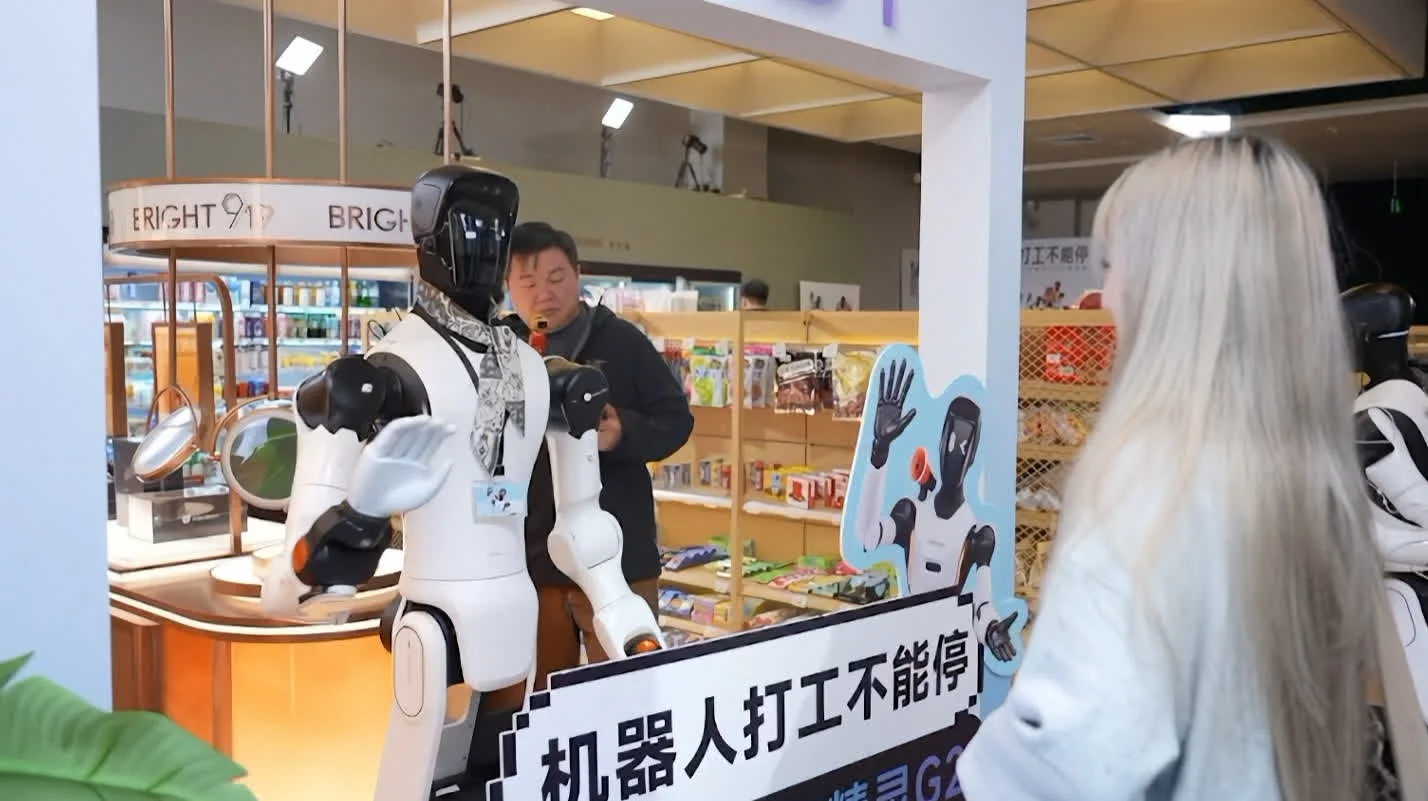
AGIBOT ran six G2 wheeled humanoids for 24 hours in an operating Shanghai convenience store and reported 1,730 completed tasks, from coffee and checkout to restocking. Only four of the six passed the final assessment; reports say the cleaning robot and a shelf-patrol unit struggled. That candour is useful. It shows that the hardest part is not doing a task once, but doing it reliably through a lunch rush, the night shift and an overflowing bin.
Showrooms and stages: conversation first
Other deployments rely on talking rather than moving. UBTECH agreed to supply 400 U1 Pro bionic humanoids to car dealer Yongda Auto for product explanations and customer service in showrooms; the U1 Pro does not walk on its own and greets visitors from a fixed position. Xinhua unveiled two bionic humanoid news anchors built with UBTECH, describing them as assistants to journalists. Simplexity launched iX, a wheeled robot that can prepare and deliver drinks and give guided tours.
Hospitals: slow and careful
Healthcare moves more cautiously. Hallym University Sacred Heart Hospital tested an early wheeled humanoid that delivers supplies and moves equipment in a mock ward, with clinicians defining the tasks. In Taiwan, an ASUS executive told a Hon Hai Tech Day panel that hospitals need a complete solution covering registration to home care, not a single robot, and that the real test is whether a deployment can be repeated at a second, third and fourth site.
What separates pilots from products
Across these cases, three factors decide whether a customer-facing humanoid becomes a product:
- Reliability over long shifts, not just impressive single tasks
- A clear job that customers notice and value, such as explanations, deliveries or drinks
- A cost the site can accept, and a setup that can be copied to the next location
What to watch
Watch for repeat orders after the first showroom deliveries, published uptime figures from retail trials and the first hospital deployments beyond simulation centres. The companies that share failures as openly as successes will earn the trust that public-facing robots need.
Editorial perspective: The person waiting should not have to troubleshoot the robot
A shopper waiting for coffee can usually walk away. A visitor asking which car to test-drive can turn to a salesperson. A ward employee waiting for a gown may have no equivalent fallback. Putting all three under “customer-facing” hides a crucial difference: who bears the cost while the robot tries again? A polite greeting does not make a long or uncertain wait acceptable.
We would design each service around a visible handoff. In a showroom, offer the visitor a person without making them repeat the whole conversation. In a store, let staff cancel a stalled order without charging twice. In a future ward trial, make it clear who owns an undelivered item. Measure the time from failure to a useful human response. A robot that hands over promptly can provide better service than one that insists on finishing.