Asia-Pacific · Analysis
Standards Before Scale: How Asia-Pacific Is Writing the Rulebook for Humanoids
In November, China published five humanoid industry standards and LG joined Korea's new humanoid safety certification effort. The region is starting to define what a capable, safe humanoid is before mass deployment, and that will shape who wins contracts.
3 min read
How do China and Korea assess humanoid robots differently?
China’s standards describe capabilities and test methods. Korea’s KIRIA pilot focuses on safety assessment. Neither alone establishes that different vendors’ machines will work together at one site. Sources
Why standards matter now
For most of 2026, humanoid news was measured in demos, funding rounds and shipment claims. In November the conversation moved to a less visible question: who decides whether a humanoid is capable, safe and ready to buy? Two announcements, one in Beijing and one in Seoul, show that Asia-Pacific governments and companies are now writing those rules.
China turns capability into a grade
On November 16, China's Ministry of Industry and Information Technology approved five humanoid industry standards, managed by its humanoid and embodied intelligence standards committee. They took effect on publication and cover:
- Building training grounds for humanoids (SJ/T 12353-2026)
- Managing training data (SJ/T 12354-2026)
- Grading intelligence from L0 to L5 across perception, decision-making, execution and interaction (SJ/T 12355-2026)
- Electric-drive integrated joints (SJ/T 12356-2026)
- Dexterous hands (SJ/T 12357-2026)
The L0 to L5 framework is the most important piece. It gives buyers, testers and investors a shared way to describe what a robot can actually do, instead of relying on marketing terms such as "general purpose." Shared test methods for joints and hands also help component makers sell into many robot brands.
Korea builds a safety gate
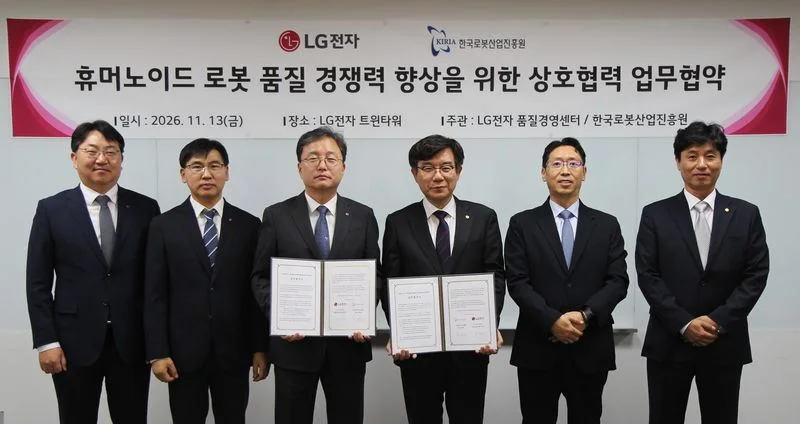
In Seoul, LG Electronics signed an agreement on November 13 with the Korea Institute for Robot Industry Advancement (KIRIA) to help build the assessment system for its Humanoid Robot Safety Certification Center. LG plans to put robots including CLOiD through pilot certification and to feed its development experience into the test criteria. Korea is also setting rules through funding: the Next-X Humanoid Challenge will not accept teams that buy and modify complete foreign humanoids.
Interoperability is the next gap
Safety and capability are only part of the picture. At a Hon Hai Tech Day panel reported by TechOrange, a Google Cloud speaker described two robots from different brands blocking each other in a hospital corridor because they could not communicate. He argued for common protocols, identity tracking and audit trails for robots and AI agents. As fleets mix brands, buyers will ask for these features in contracts.
What to watch
The first companies to have their robots graded and certified will gain an edge in public procurement, insurance and large enterprise deals. Watch for the first published L-level ratings in China, the first pilot certifications at KIRIA, and whether Japan, Taiwan and Singapore align their own testing with these frameworks or develop separate ones. A fragmented rulebook would raise costs for exporters; a shared one could speed adoption across the region.
Editorial perspective: The gap between two certificates can be a corridor wide
A hospital could buy two machines that each meet its tender requirements and still end up with a blocked corridor. A capability grade describes what one machine can do. A safety assessment can establish how it behaves under the conditions tested. Neither, by itself, tells the hospital which of two approaching machines will yield, or which supplier answers the phone if both wait indefinitely.
Our recommendation for regional buyers is to put one shared encounter in the acceptance test, not just two separate certificates in the contract file. Give a delivery robot and a second machine conflicting routes, interrupt the connection, and ask the suppliers to show who can clear the passage and reconstruct the event. That test would not replace certification. It would expose the part of the installation for which no individual certificate is responsible.