Asia-Pacific · Analysis
From Parts to Platforms: Taiwan's Humanoid Industry Steps Up to Complete Robots
Taiwan has long supplied the chips, motors and gearboxes inside other companies' robots. With ASUS training its first humanoid on a real production line and Foxconn pushing vertical integration, the island is now testing whether it can build and sell complete humanoids.
3 min read
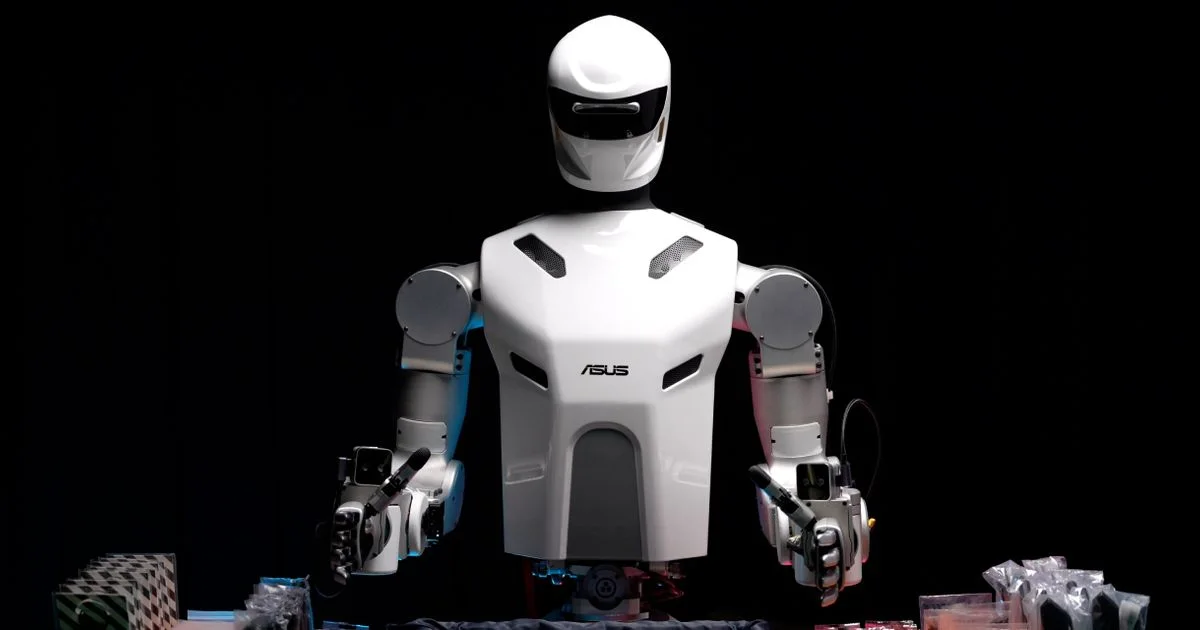
Can Taiwan move from humanoid components to complete robots?
ASUS is testing Gallop in its own manufacturing environment, while Foxconn sees scale in repeating tasks across lines. Selling a maintainable system to an outside factory remains a separate test. Sources
A supplier with bigger ambitions
A humanoid has dozens of joints, and each needs motors, reducers, screws and sensors. Taiwan already makes many of them. According to Taiwanese financial media, companies such as HIWIN supply harmonic reducers and linear guides, Delta Electronics and TECO provide servo motors and drives, and TSMC manufactures the AI chips robots rely on. Until now, Taiwan's role has mostly been inside other brands' robots. In November, that started to change.
ASUS trains a humanoid on a real line
ASUS published details on November 13 of Gallop, its first humanoid. It has a fixed base, two arms and an in-house dexterous hand, and runs on NVIDIA Jetson AGX Thor. Its first job is packing motherboard accessories at an ASUS group EMS plant, a station with 15 small parts, many in thin clear bags. The target is 99.5% success within about 20 seconds, the same bar as a human worker. Customer pilots are planned for 2027 and market availability for the second half of 2028.
Foxconn's case for scale
At the Hon Hai Tech Day robot panel reported by TechOrange, Foxconn's robotics business head Kuo Liu-tsung said Taiwan's robot supply chain is "not necessarily that mature" yet and that Foxconn wants to contribute through vertical integration. He noted Foxconn has thousands of SMT electronics assembly lines with very similar tasks, so robots trained at one or two sites could be deployed widely. His blunt view: without economies of scale, much of the talk is empty. China leads in volume, he said, and if Taiwan catches up, the supply chain will follow.
Taiwan's advantages and gaps
Taiwan brings three advantages to complete humanoids:
- Precision components and AI chips already in global robot supply chains
- Electronics factories that can serve as large, repeatable training and deployment sites
- Experience turning prototypes into reliable mass-produced hardware
The gaps are equally clear. Taiwanese reports note that robot revenue is still a small share of most suppliers' sales, and that product validation and shipments need to be proven. ASUS's own executive told the panel that robot value lies less in hardware than in solving problems that customers will pay for.
What to watch
Watch whether Gallop hits its 99.5% target on the ASUS line, whether Foxconn shows humanoids working across multiple SMT sites, and whether Taiwanese component makers win orders from overseas humanoid makers seeking non-Chinese supply chains. If those three things happen in 2027, Taiwan could become one of the few places that can supply both the parts and the finished robot.
Editorial perspective: The second customer is a different test from the second factory
Moving Gallop from one group factory to another would be meaningful engineering progress. Selling it to an unrelated manufacturer asks something harder. The buyer may use different trays, refuse to share production video, or expect a service technician rather than an ASUS research engineer when the line stops. None of those objections is solved by a more dexterous hand alone.
Taiwan’s component makers need not all become robot brands to benefit. A supplier that makes a joint easy to replace, or a fault easy for a technician to diagnose, can help a complete system win that outside customer. In a future pilot, we would ask who installed the second station, how much had to be customized, and who signed off on the result. Those details would show whether Taiwan is exporting a repeatable product or a project that still travels with its designers.