Asia-Pacific · Analysis
The Data Factory Race: Why Asia Is Paying People to Teach Robots
What turns a recorded robot movement into a useful lesson? Projects in Wuhan, Daejeon and Tokyo suggest three ways to judge the value of physical AI training data: variety, reuse and recovery from mistakes.
4 min read
What are humanoid robot data factories in Asia for?
Facilities in Wuhan, Daejeon and Tokyo collect or plan to collect demonstrations for physical AI. Their published figures measure different things: clips, operating robots or target training hours. Sources
Robots need lessons, not just code
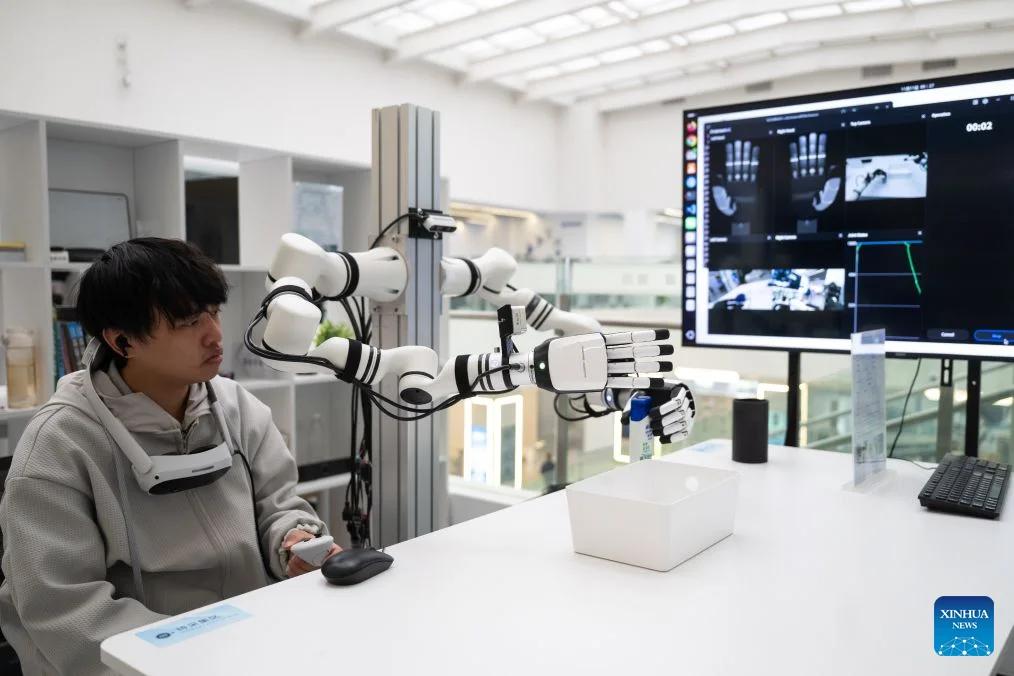
Large language models learned from text that already existed on the internet. Humanoids have no such library. To learn how to fold laundry, open a fridge or pack small parts, they need recordings of the task being done by a robot body, with matching camera, force and joint data. The fastest way to get that today is to have people operate robots remotely and record every move. Across Asia-Pacific, that work is moving from university labs into dedicated facilities.
Three facilities, one model
In Wuhan, Xinhua reports that the Hubei Humanoid Robot Innovation Center has about 40 trainers working in a space of more than 3,000 square metres and produces more than 20,000 usable data pieces a day, serving over 140 robotics firms in the province. In Daejeon, KIMM opened its AI Humanoid Data Factory on November 3, with 12 humanoids teleoperated through household and vehicle tasks. In Tokyo, Atom opened a Physical AI Foundry in August and aims to have 200 robots running continuously and 300,000 cumulative hours of training data by the end of 2027.
- Hubei: about 40 trainers, 20,000+ usable data pieces a day
- KIMM: 12 teleoperated humanoids, household and mobility tasks
- Atom: target of 200 robots and 300,000 hours of data by end-2027
Diversity beats volume
The facilities differ on what they collect. KIMM deliberately mixes household and in-vehicle scenes rather than repeating a single factory task, and describes a loop of collecting data, training models, deploying them and collecting again. That matters because a robot trained on one workstation often fails at the next. Commercial trials add another source: AGIBOT's 24-hour convenience store test generated a full day of real customer interactions that no lab could script.
Rules for data are arriving
China's new standards include one on building training grounds and one on managing training data. That signals that data collection is being treated as infrastructure that needs quality control, not as a side project. Expect buyers and regulators to ask where a robot's training data came from, how it was labelled and whether it was collected with consent in public settings.
Compute follows data
Atom's 4.5 billion yen in bank credit lines is earmarked partly for its own GPU cluster to train and test physical AI models. Korea's Next-X challenge will give selected teams access to government GPUs, physical AI data and simulation. The pattern is the same: whoever controls data and compute can iterate fastest.
What to watch
Key questions for 2027 are whether data from one robot body can be reused on another, whether shared public datasets emerge, and how much a usable hour of robot data really costs. The data factories that answer these questions will shape which companies can afford to train competitive robots.
Editorial perspective: The most valuable recording may be the one a trainer would delete
Imagine a trainer reaching for a transparent bag, missing it, then changing the angle and succeeding. If a facility keeps only the clean second attempt, its dataset describes success but loses the link between a visible mistake and a useful correction. A facility rewarded solely for the number of usable clips could make that choice rational for the operator and costly for the model developer.
Rather than rank Wuhan, Daejeon and Tokyo by clips, robots or planned hours, we would ask each the same question: what improved on a task kept out of training? One practical comparison would train with and without the recovery sequences, then count how often the robot needs a person on an unfamiliar workstation. That gives a buyer a reason to pay for carefully annotated failures, not merely for more recording time.