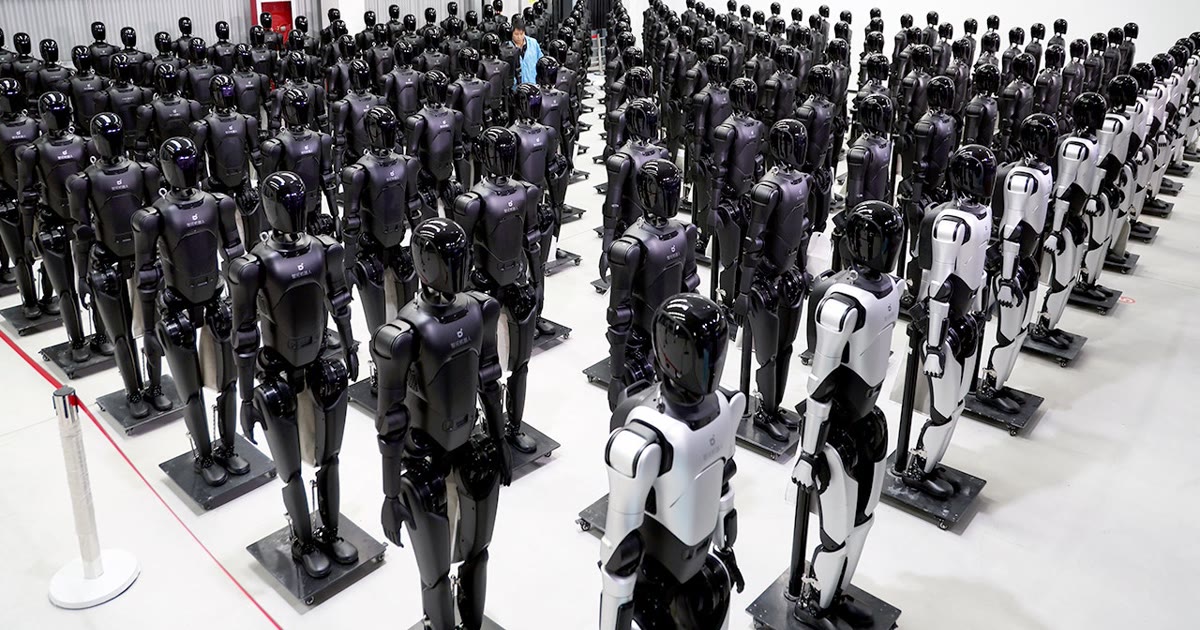
Humanoid robot prices in China have fallen dramatically over the past two years, with some consumer-oriented units now selling for under ¥10,000 (roughly $1,400) — down 72% from an average price of ¥593,400 in 2023, according to reporting from Seoul Economic Daily published June 15, 2026. The price collapse coincides with a major policy push from China's Ministry of Industry and Information Technology (MIIT) and the State-owned Assets Supervision and Administration Commission (SASAC), which have launched the "2026 Humanoid Robot and Embodied Intelligence Real-Scene Training Special Action" — a mandate targeting more than 10,000 commercial humanoid deployments by the end of 2026.
According to Embodied Global's coverage of the mandate, the initiative is explicitly designed to push humanoid robots out of research labs and demo stages into real commercial environments — factories, warehouses, retail spaces — at meaningful scale, rather than continuing the pattern of impressive but limited pilot deployments that has characterized much of the industry's public messaging to date.
State-Owned Enterprises Leading Deployment
Major state-linked and private manufacturers including SAIC, BYD, and Foxconn are reportedly already deploying humanoid robots on production lines as part of the broader push, giving the mandate real industrial weight beyond a policy announcement. When some of China's largest automakers and electronics contract manufacturers are integrating humanoids into their own manufacturing operations, it signals that the cost and reliability threshold for productive deployment — not just demonstration — has been crossed for at least some structured industrial tasks.
How Falling Prices and Policy Reinforce Each Other
The relationship between the price collapse and the deployment mandate runs in both directions. Lower component costs — batteries, actuators, sensors — make the government's 10,000-unit deployment target economically realistic in a way it would not have been at 2023 price levels. At the same time, a government-backed guarantee of deployment volume gives manufacturers the demand certainty needed to invest in the manufacturing scale that drives prices down further. Together, the two forces suggest China's humanoid robot costs are likely to keep falling through the rest of 2026, even as the MIIT mandate pushes adoption into a wider range of commercial settings than most other countries have yet attempted.