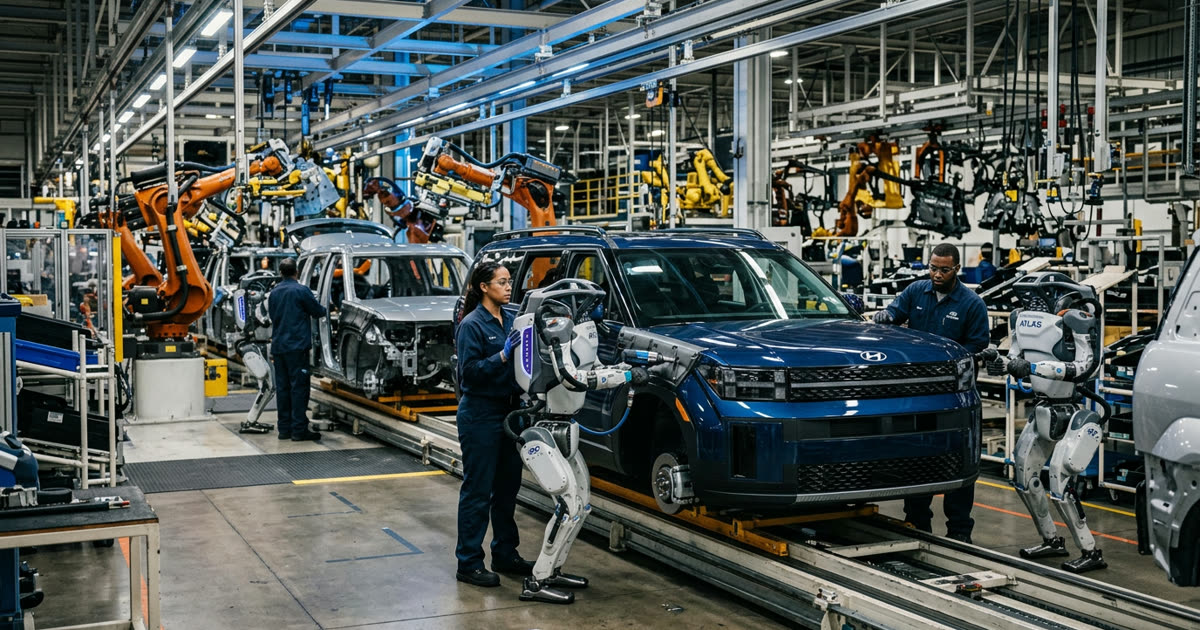
In what analysts are calling a watershed moment for humanoid robotics commercialization, Hyundai Motor Group has confirmed plans to deploy approximately 25,000 Boston Dynamics Atlas humanoid robots across its automotive manufacturing facilities over the coming years. The disclosure, reported by Wedoany, represents the largest single humanoid deployment commitment made public by any industrial operator worldwide, dwarfing previous pilot programs that measured deployments in dozens or hundreds of units.
Boston Dynamics (Boston Dynamics), a Hyundai subsidiary since 2021, developed the electric Atlas platform specifically for industrial deployment after retiring its hydraulic predecessor. The electric Atlas is lighter, quieter, and capable of onboard AI inference in ways the hydraulic platform was not. Hyundai Motor (Hyundai Motor) is uniquely positioned to serve as both Atlas's parent company and its most demanding customer — a structural advantage that allows rapid iteration between factory feedback and hardware development cycles.
Scale, Scope, and Timeline
The 25,000-unit figure spans Hyundai's global manufacturing network, which includes major plants in Korea, the United States, Czech Republic, India, and Indonesia. Deployment is expected to be phased over several years, beginning with high-volume, repeatable assembly tasks where humanoid robots can operate alongside existing automation without full line redesign. Target applications include wheel and module installation, quality inspection routines, and component logistics within plant boundaries — tasks where Atlas's bipedal form factor offers significant access advantages over fixed-arm industrial robots that require bespoke tooling and dedicated floor space.
Why This Matters Beyond Hyundai
The Hyundai announcement is significant not just for its scale but for what it signals to the rest of the automotive and manufacturing sectors. No other OEM had previously committed to humanoid deployment at four or five-digit unit volumes. If Hyundai demonstrates measurable productivity gains at even a fraction of that scale, it will accelerate competitive pressure on Toyota, Volkswagen, and other global automakers to develop their own humanoid deployment roadmaps. It also validates the investment thesis for the entire Atlas supply chain — actuators, compute, sensors, and integration software providers that have been waiting for a bankable anchor customer.
For Boston Dynamics, the arrangement transforms what had been a demonstration-heavy product reputation into a genuine volume manufacturing story. The company now has a committed anchor customer at a scale that justifies dedicated production line investment and long-term software support contracts. The implications for APAC manufacturing competitiveness are substantial: Korea is now ahead of Japan and China on publicly disclosed humanoid units committed to automotive deployment, establishing a competitive benchmark that other regional industrial powers will be watching closely. The deployment timeline will be a key indicator of whether humanoid robots can meet the reliability and uptime standards that automotive production demands.