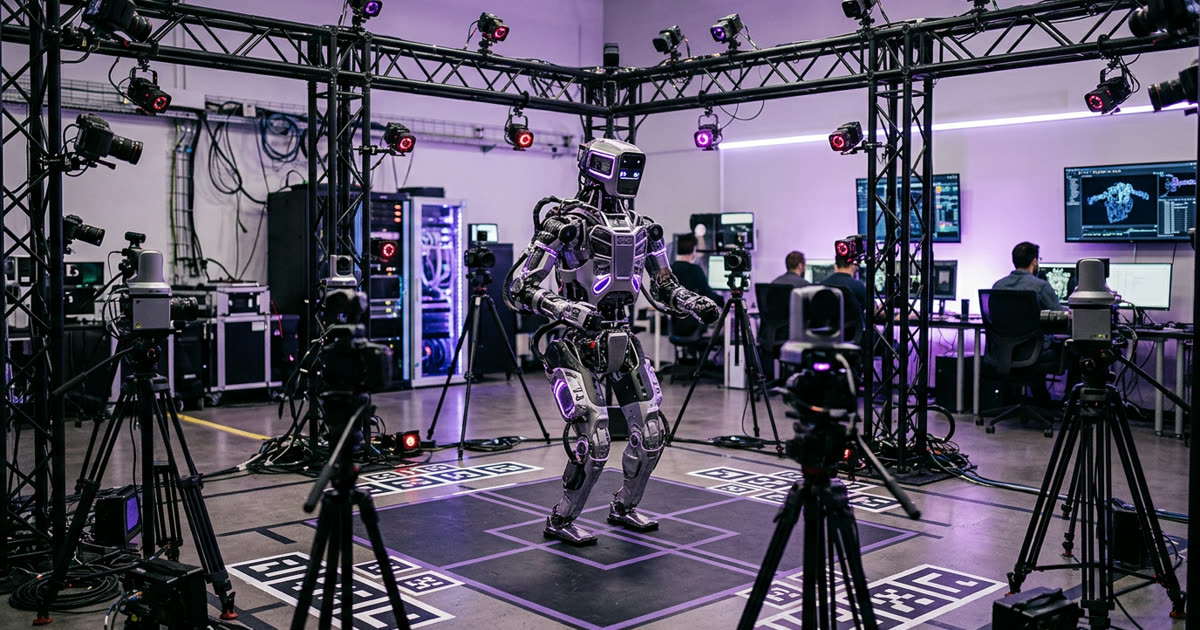
LG Electronics opened the CLOiD data factory in Yangjae, southern Seoul, on June 11, 2026 — a facility explicitly designed to solve one of humanoid robotics' most stubborn bottlenecks: the shortage of high-quality, diverse human-motion and manipulation training data. The opening was reported by both Chosun Ilbo and Korea Herald, with LG confirming (LG Electronics) that the facility will operate on a continuous multi-shift basis to build the proprietary datasets that underpin its humanoid AI development roadmap. LG described the investment as a long-term infrastructure commitment rather than a short-cycle research project.
Unlike conventional software data centers, the CLOiD factory is a physical capture environment — instrumented with multi-angle camera arrays, motion-capture rigs, force and torque sensors, and teleoperation systems. Human operators perform everyday manipulation tasks — picking, placing, folding, sorting, assembling components — while the facility's sensor network records synchronized multimodal data streams. The result is a structured corpus of human dexterity data that can be used to train imitation-learning and reinforcement-learning models for LG's CLOiD humanoid platform. The facility is designed to support hundreds of distinct task scenarios across multiple environmental configurations.
Why Training Data Is the Constraint
The fundamental challenge for humanoid AI today is not hardware capability — it is generalization. A robot that performs well in a controlled lab often fails in the variability of real environments because its training data is too narrow or too clean. Industrial-scale data factories like LG's CLOiD facility address this by systematically varying objects, lighting, surface textures, and task sequences to produce datasets broad enough to train robust manipulation policies. LG is betting that ownership of a proprietary, large-scale dataset will become a durable competitive advantage as the humanoid market scales. The value of such datasets compounds over time as they are enriched with real deployment feedback.
Strategic Position Within LG's Humanoid Program
The CLOiD factory is one of three pillars in LG's humanoid strategy, alongside its hardware platform development and a recently announced partnership with NVIDIA for AI compute and foundation model infrastructure. Together, these investments signal that LG intends to compete on the full AI-hardware-data stack rather than licensing a platform from a third party. This is a higher-risk, higher-reward posture than assembling a product around an external foundation model, and it reflects LG's conviction that data ownership will be the defining moat in the humanoid industry.
The Yangjae facility's location — in a dense technology and startup corridor south of the Han River — also positions LG to recruit AI researchers and collaborate with nearby university labs. The district already houses several AI and robotics-adjacent companies, and LG's CLOiD investment elevates the area as a robotics data infrastructure hub. Korea's humanoid ecosystem is consolidating around a small number of well-capitalized anchor players, and LG's CLOiD investment makes clear it intends to be among them, with data as its most defensible long-term asset.