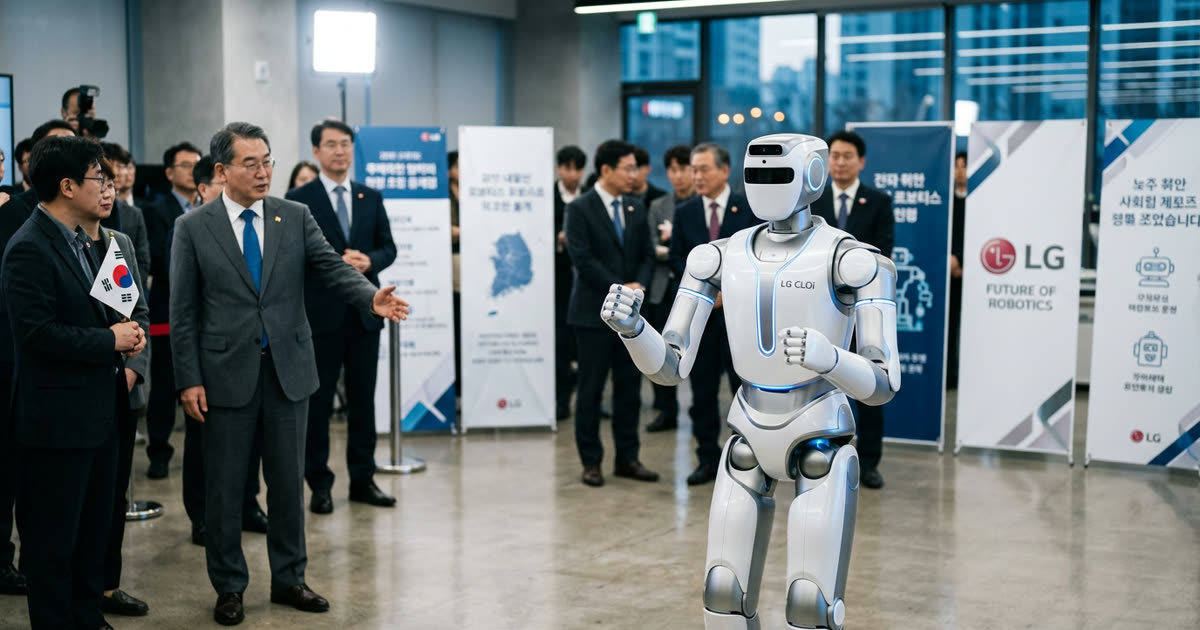
South Korea formally entered the national humanoid robotics race on May 18, 2026, when the Ministry of Science and ICT (MSIT) announced the K-AI Humanoid Program — a government-backed initiative funded at ₩50.4 billion (approximately USD $37 million). According to Seoul Economic Daily, the program is designed to produce a domestically developed AI and humanoid technology stack, reducing dependence on foreign platforms for what Seoul views as a strategically critical capability. The program will run in two phases, with initial deliverables expected within 18 months.
The program's two anchor industry partners are LG Electronics, which contributes hardware, sensor integration, and manufacturing expertise, and WIRobotics, a Korean startup specializing in wearable and ambulatory robotic systems. MSIT, listed at MSIT, will oversee program governance, milestone funding, and technology transfer obligations. LG Electronics (LG Electronics) brings institutional scale that smaller domestic robotics firms cannot match, including its existing home appliance AI platform and global manufacturing infrastructure.
Sovereign AI as a Policy Imperative
The K-AI label is deliberate. Seoul is positioning this program as part of a broader sovereign AI agenda — the belief that critical AI infrastructure, including the models, sensor pipelines, and physical AI frameworks that run humanoid robots, should be developed and owned domestically. The program will fund foundation model development, robot-specific training data pipelines, and standardized hardware reference designs that Korean manufacturers can license and build upon. Academic partners from KAIST and Seoul National University are expected to participate in the foundational model research phase.
Competitive Context in APAC
Korea's program arrives as China has mandated 10,000 commercial deployments by end-2026, and as Japan accelerates its own physical AI initiatives through industry–university research pacts. The ₩50.4 billion envelope is modest by comparison to China's state-procurement levers, but the program's emphasis on full-stack domestic ownership — from foundation models through to hardware certification — reflects a different strategy: depth over scale. If successful, K-AI would give Korean firms a proprietary competitive moat rather than making them dependent on U.S. or Chinese platform providers. The program is also designed to ensure that intellectual property generated under the collaboration remains within Korea's industrial ecosystem.
Near-term milestones expected under the program include a public reference humanoid prototype by mid-2027 and a certified domestic AI inference framework for real-time robot control. Korea's broader industrial base — deep in semiconductor, display, and battery manufacturing — gives the program structural advantages when it comes to sensor and compute integration that pure robotics startups lack. Observers will watch whether the program's IP governance model is open enough to encourage participation from smaller Korean robotics firms, or whether it consolidates benefits primarily among the large conglomerates.