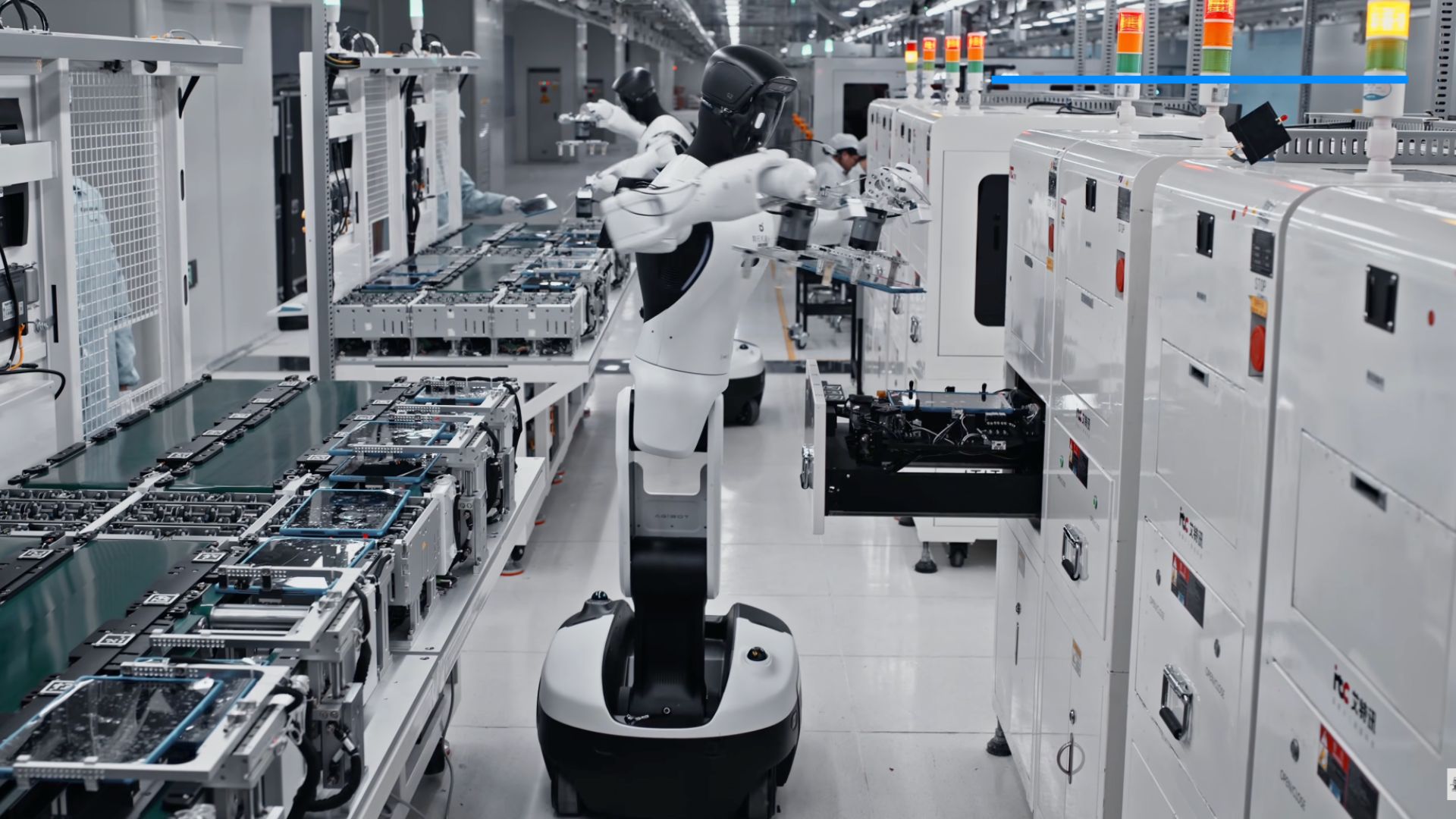
For most of 2023 and 2024, humanoid robots made headlines by doing things that looked impressive on a stage: dancing, carrying boxes, opening doors. In the second half of 2025, two Chinese companies did something far more consequential — they made humanoids show up to work, every day, on actual production lines.
AgiBot: First to 5,000
On 8 December 2025, Shanghai-based AgiBot (Zhiyuan Robot) became the first humanoid company in the world to ship 5,000 production units. Co-founder Peng Zhihui also outlined targets of 10,000 units in 2026 and 100,000 units long-term. The company carries an estimated valuation of ¥15 billion (approximately USD 2.1 billion), with strategic shareholders including Tencent, BYD, TCL, and CATL — the same industrial and technology constellation that underpins China's electric vehicle dominance.
AgiBot's G2 humanoid is operating in live production at a Longcheer Technology facility, running electronics assembly and test workflows. Reported performance: approximately 3,000 units processed per shift, with each task cycle completing in 18–20 seconds and per-robot output of roughly 310 units per hour. AgiBot is targeting 100 deployed robots by Q3 2026 across automotive, semiconductor, and electronics customers, with a training partnership signed with Minth Group in March 2026 for real-world factory data collection at scale.
UBTECH × BYD: Hundreds of Walkers on the Line
UBTECH Robotics began large-scale industrial delivery of full-size humanoids in November 2025, reaching 1,079 Walker S2 units delivered across 2025 to BYD, Geely, FAW-Volkswagen, Dongfeng, and Foxconn. The Walker S2 features autonomous battery swapping designed for 24-hour, 7-day continuous operation — a capability specifically engineered for the continuous-production demands of automotive plants.
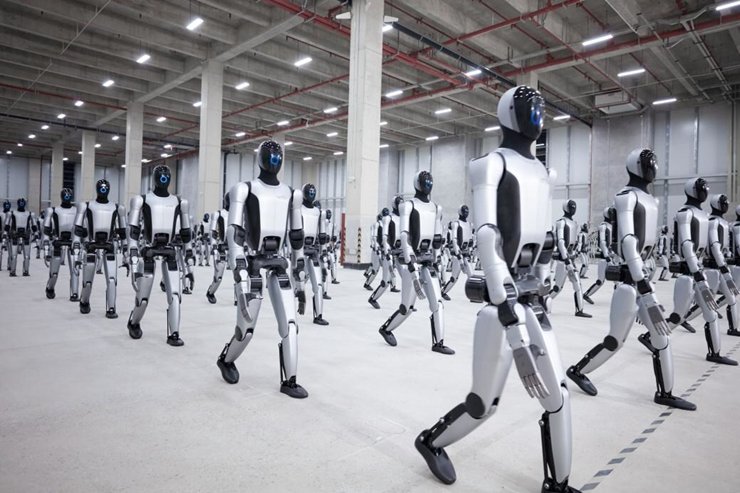
UBTECH reported FY2025 revenue of ¥2.001 billion, up 53.3% year-on-year — the highest disclosed revenue among publicly reporting humanoid companies globally. The BYD deployment — 100 to 200 Walker S2 units in logistics, handling, and assembly — represents the largest commercial humanoid deployment globally as of year-end 2025. BYD's role is not incidental: it is also an AgiBot shareholder, reinforcing the pattern of Chinese automotive groups building equity stakes in humanoid vendors as both strategic bets and procurement relationships.
The Shipment Scoreboard at Year-End 2025
Cumulative humanoid shipments by the end of 2025 tell a clear story. AgiBot led with 5,000 units. Agility Robotics (US) followed at approximately 3,000, Unitree (China) at 2,000, and UBTECH at approximately 500. Three of the top four are Chinese; AgiBot alone exceeds the combined output of the next two competitors.

For APAC market observers, these numbers carry a structural implication: the learning-curve advantage in humanoid manufacturing is accumulating on the China side of the ledger faster than any other region. The combination of higher unit volumes, real-world deployment data from live factories, and government-backed supply chain development means that the gap between Chinese and non-Chinese humanoid producers is likely to widen before it narrows. The factories that are running today are not just producing robots — they are generating the operational data, maintenance insights, and reliability benchmarks that will define competitive advantage in Wave 2 and Wave 3 deployments.