At a glance
Seoul Economic Daily’s October 13, 2026 report says South Korea approved a regulatory-sandbox project for 20 Robros humanoids at four industrial sites. The approval covers planned tests, not completed deployments or demonstrated safety results.
South Korea approves a 20-robot factory test project
South Korea’s Industrial Convergence Regulatory Sandbox Review Committee has granted Robros an exemption to conduct live humanoid-robot testing, according to Seoul Economic Daily’s account of the sandbox clearance. The approved project plans to place 20 Robros bipedal humanoids at four industrial sites, spanning semiconductor packaging, automotive production, shipbuilding and logistics, as Seoul Economic Daily reports on the 20-robot plan.
The planned host companies are Nepes, Sungwoo Hitech, HD Hyundai Samho and Delivery Lab, with robots operating in spaces shared with or near human workers, the newspaper reports. This is regulatory permission for planned field tests, not evidence that the robots have completed deployments or met operational targets. Seoul Economic Daily
Four industrial tasks put adaptability and precision in focus
The proposed work is specific to each host site: at Nepes, robots are to remove contaminants from circular components used in semiconductor packaging; at Sungwoo Hitech, they are to position automotive body parts. At HD Hyundai Samho, the planned task is stacking scaffolding brackets used in ship construction, while Delivery Lab is to test moving refrigerated-logistics packaging. Seoul Economic Daily’s account of the four-site tests
These assignments put different handling demands in one test program, and the report says the variety will help assess how humanoids adapt to differing conditions and levels of precision. The report does not specify the exact robot configuration at each site, task volumes, operating hours or acceptance thresholds, so the task descriptions should not be read as measured capabilities. Seoul Economic Daily
Editorial analysis: Treat the sandbox as a test of governance, too
For APAC manufacturers and regulators, the practical significance is not simply that humanoids may enter factories; it is that a permission framework is being tested where people and robots may work close together. That makes the conditions of access, supervision and incident response as important to evaluate as task completion. Operators considering similar trials should ask who sets the boundaries of each work zone and who can stop a robot when a worker enters it.
The four settings also offer a useful way to compare trial design, rather than assume that success in one operation transfers to another. Before treating any result as relevant to a different site, decision-makers should ask what counts as a successful task, how repeatability and errors are recorded, and whether performance is assessed alongside worker exposure and interruptions. Those are due-diligence questions, not claims that the announced project already answers them.
What remains unverified as tests proceed
South Korea’s government intends to use test data to revise humanoid safety standards, the report says, because existing industrial-robot rules assume stationary machines and commonly rely on barriers separating people from robot work areas. The report also says Trade Minister Kim Jung-kwan argued that institutional barriers preventing companies from applying new technologies at industrial sites need to be removed. Seoul Economic Daily
The announcement does not disclose robot-level performance or safety results, and it gives no completed-trial findings; those remain matters to verify after testing. It is also identified as an AI translation from Korean, with a caution that quoted wording may not exactly match the original reports. Seoul Economic Daily
Sources and reporting notes
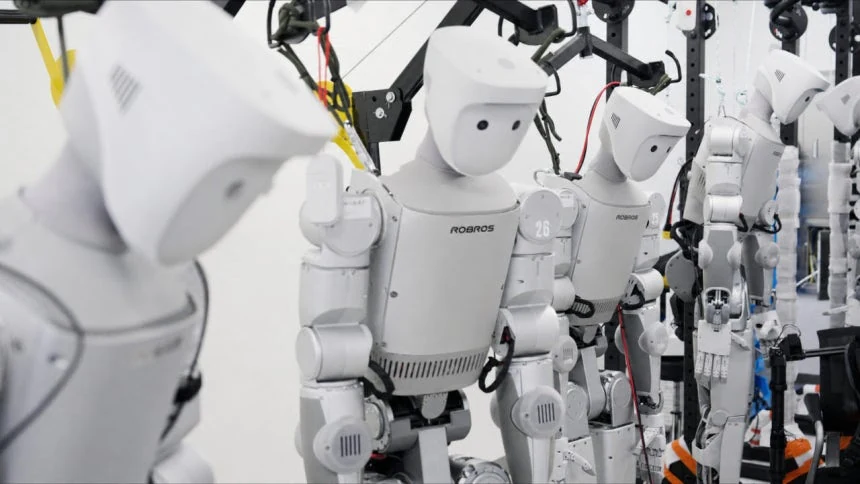
Based on a Seoul Economic Daily media account, identified as AI-translated from Korean. It reports approval and planned tests, not independent trial results. The separate ROBROS archive photograph depicts IGRIS-C robots, not the newly approved factory trials.
Original synthesis and analysis of the linked public reporting. AI-assisted drafting and translation; reported claims remain attributed to their sources.