At a glance
Neubility unveiled its wheeled humanoid Billi on September 29, 2026, presenting it as a robot that combines navigation and physical tasks. Its industrial trials are planned, and the announcement provides no empirical results for Billi’s manipulation or reliability.
Neubility unveils Billi as a wheeled robot for physical work
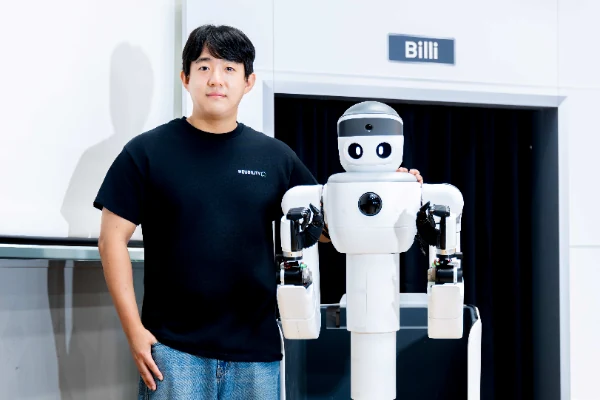
South Korean robotics company Neubility publicly unveiled Billi on September 29, 2026, describing it as a hybrid humanoid intended to connect autonomous movement with handling objects and performing physical tasks. Beyond Post’s report on the company announcement says the product builds on spatial intelligence developed through operating its Neubi autonomous delivery robot, while TechTimes’ account also describes the public reveal.
Billi has a wheeled base, an upper body with two arms and hands, and a lifting torso that can rotate 360 degrees, according to the two reports. Beyond Post says the cargo section can be configured for different tasks; TechTimes describes the proposed workflow as travelling to a pick point, adjusting torso height, grasping an item, storing it in the cargo area and transporting it.
Camera-based navigation is intended to support handling workflows
The reports say Billi navigates using cameras rather than lidar. Neubility describes camera-based, mapless autonomous driving and visual SLAM, while TechTimes notes that visual navigation can struggle in low light, visually uniform spaces and repetitive environments. Beyond Post’s account of the company’s approach and TechTimes’ discussion of its constraints therefore describe both the intended sensing method and conditions that could test it.
Neubility plans proof-of-concept trials in the second half of 2026 in food-and-beverage manufacturing, logistics and distribution, and transport hubs. The company says these trials will assess task performance, operating stability and site suitability, while generating data on spatial understanding, movement, approach, object recognition and manipulation. Beyond Post reports the company’s trial plans; TechTimes likewise describes the planned proof-of-concept work as a test, not a published result.
Editorial analysis: APAC buyers should examine the handoff between movement and manipulation
For APAC manufacturers and logistics operators, the important question is not simply whether a wheeled robot can reach a workstation. It is whether navigation, approach, grasping, loading and onward transport work as one repeatable operation under the site’s actual layout, lighting, traffic and object variation. A useful evaluation should separate successful movement from successful task completion, and record where a workflow fails or requires human intervention.
Buyers should ask which tasks and objects a trial will cover, how success and reliability will be measured, and whether results include recovery from missed grasps, blocked routes or changes in object placement. They should also clarify how the robot will be supervised, how modular cargo configurations affect the work sequence, and whether performance is assessed across shifts and operating conditions. These are due-diligence questions, not claims about Billi’s present capability.
Navigation history does not yet establish manipulation performance
TechTimes reports that Neubility’s Neubi delivery robot has completed more than 44,000 operations across 140 sites in South Korea and Japan, and that the company is using this operational history to develop a Spatial Robot Foundation Model. The same report distinguishes Neubi’s navigation role from object manipulation and says it has seen no published evidence that navigation-heavy data improves Billi’s manipulation performance. TechTimes reports those figures and the unresolved transfer question; Neubility’s announcement, as reported by Beyond Post, refers instead to operations at more than 150 sites.
That difference in reported site counts should be kept attributed to each account rather than treated as a settled, directly comparable metric. The announcement and media coverage do not provide empirical results from Billi’s manipulation trials, quantified reliability measures or a disclosed price. Beyond Post reports the company’s plans for trials and data collection, while TechTimes notes the evidence gap around manipulation; operators should verify trial protocols, results and the relationship between navigation data and handling outcomes before drawing conclusions.
Sources and reporting notes
The launch and product details are attributed to Neubility’s announcement as reported by Beyond Post; TechTimes provides additional reporting and cautions about navigation and manipulation. Neither account supplies independent performance results for Billi.
Original synthesis and analysis of the linked public reporting. AI-assisted drafting and translation; reported claims remain attributed to their sources.