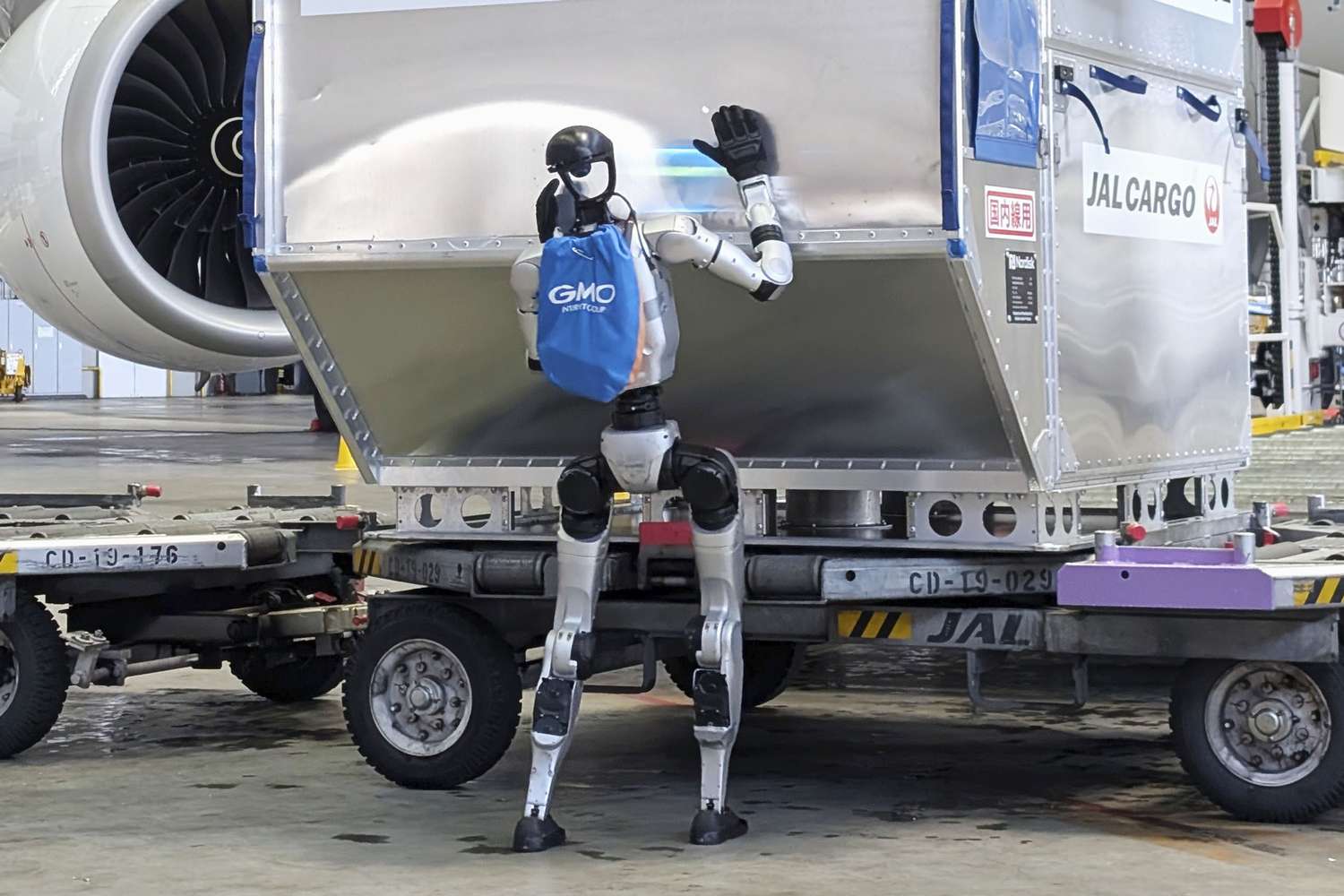
Japan is preparing one of Asia's most practical humanoid robot trials: deploying humanoid robots to support baggage handling at Tokyo's Haneda Airport — one of the world's busiest aviation hubs.
Japan Airlines and GMO AI & Robotics have launched a trial at Haneda Airport where humanoid robots assist with ground-handling operations including moving luggage and cargo. The robots are developed by Unitree Robotics, one of the most globally visible humanoid robot companies from mainland China.
According to reports from The Guardian and aviation industry sources, the trial may run in phases through 2028, with human workers continuing to handle all safety-critical responsibilities. This is a key point: the goal is not to replace ground staff, but to test whether humanoid robots can assist with physically demanding tasks under human supervision.
Why Airport Baggage Handling Is the Right Use Case
Airport baggage handling is one of the clearest real-world use cases for humanoid robots. It involves repetitive physical work, heavy lifting, labor shortage pressure, and a semi-structured operating environment. Unlike a pure demonstration, airport ground handling has measurable productivity, safety, and reliability requirements — exactly the conditions needed to validate commercial viability.
Japan's labor shortage is one of the main drivers behind robotics adoption. Airport operations are especially vulnerable because Japan is seeing strong inbound tourism growth while facing an increasingly aged workforce. Humanoid robots can help reduce physical strain on workers and support tasks that are difficult to staff consistently.
Why a Humanoid Form Factor Makes Sense in Airports
Airports are designed for human movement: stairs, carts, doors, ramps, containers, tools, and mixed indoor-outdoor environments. A humanoid form factor is valuable when robots need to operate in spaces originally designed for people, rather than environments rebuilt around traditional fixed automation systems.
For Unitree Robotics, the Haneda trial strengthens international visibility. Known for its quadruped robots and humanoid G1 and H1 platforms, a successful airport trial would move Unitree's humanoids from viral videos and exhibitions into operational infrastructure — a significant credibility milestone.
What It Means for APAC Aviation
This trial could become a reference case for airport operators across Asia-Pacific. Major hubs in Singapore, South Korea, Taiwan, Thailand, Hong Kong, and mainland China all face pressure to improve operational efficiency, manage passenger growth, and reduce repetitive manual work. If humanoid robots prove useful in baggage and cargo operations, similar applications could expand to hotel logistics, warehouse loading, aircraft cabin cleaning, retail back-end operations, and transportation hubs.
Japan's airport experiment is a reminder that the most valuable robots will not necessarily be the ones that look the most futuristic. They will be the ones that solve practical, costly, and persistent operational problems — and airport baggage handling fits that description precisely.