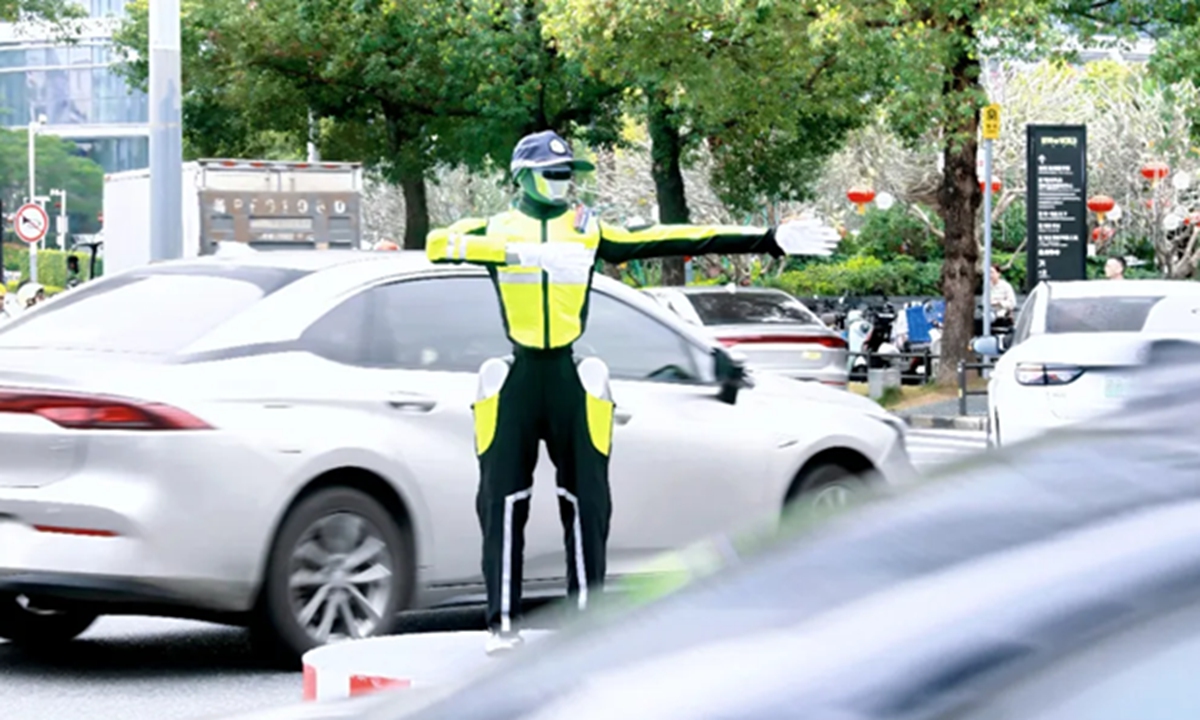
China's humanoid robot sector has entered a new phase of public visibility. A humanoid robot police officer was recently seen patrolling the streets of Shenzhen alongside SWAT officers, marking a clear shift from the factory floor and exhibition hall to live urban public-safety operations.
According to CGTN, the robot was spotted during a public patrol operation in Shenzhen, Guangdong Province, alongside local SWAT personnel. The sighting moves humanoid robots beyond the typical factory, exhibition, or laboratory setting and into a live urban environment with real crowds, unpredictable behavior, and operational demands.
China has already demonstrated strong progress in humanoid robotics through companies including Unitree Robotics, UBTECH Robotics, Fourier Intelligence, and AGIBOT. The Shenzhen patrol, however, highlights a different application direction: security assistance, crowd management, public visibility, and potentially emergency response.
Why Public-Safety Robotics Is Harder Than Factory Work
A robot operating in a shopping district, public street, or patrol route must handle moving crowds, unpredictable human behavior, uneven surfaces, visual complexity, and real-time interaction with law enforcement teams. This is fundamentally different from a controlled factory floor, where the environment can be structured and predictable. In public spaces, humanoid robots must demonstrate stronger perception, dynamic stability, navigation, and human-aware behavior — a much higher bar.
China's Broader Smart-City Ambition
The Shenzhen patrol reflects China's broader strategy to integrate robotics into everyday city infrastructure. Over the past year, China has increased national and municipal support for humanoid robotics, embodied AI, smart manufacturing, and next-generation automation. Humanoid robots are increasingly presented not only as industrial tools, but as future assistants for service, logistics, inspection, security, healthcare, and public operations.
That said, the near-term role of humanoid robots in law enforcement is likely to be supportive rather than fully autonomous: patrol visibility, route monitoring, public guidance, information display, and potentially remote teleoperation. Human officers remain responsible for safety-critical decisions.
Why Shenzhen Is the City to Watch
Shenzhen is already one of China's strongest technology hubs, with deep ecosystems in electronics, AI, drones, robotics, smart devices, and manufacturing. If humanoid robots can move from demonstrations into regular public-sector trials here, similar deployments could extend to other Chinese cities and across the wider APAC region.
What It Means for APAC
For Asia-Pacific observers, Shenzhen's humanoid patrol signals three important trends. First, humanoid robots are being tested in more visible, real-world environments beyond controlled settings. Second, China is using public-sector trials to accelerate robot maturity at pace. Third, public-safety applications may become a major humanoid category alongside logistics, manufacturing, healthcare, and home assistance.
The bigger question going forward is not whether humanoid robots can walk, run, or carry objects. It is whether they can operate safely and meaningfully in real human environments — and whether cities are ready to manage the social, legal, and ethical dimensions that come with robotic presence in public spaces.